

Syncretism, Shamanism and Sacred Geography
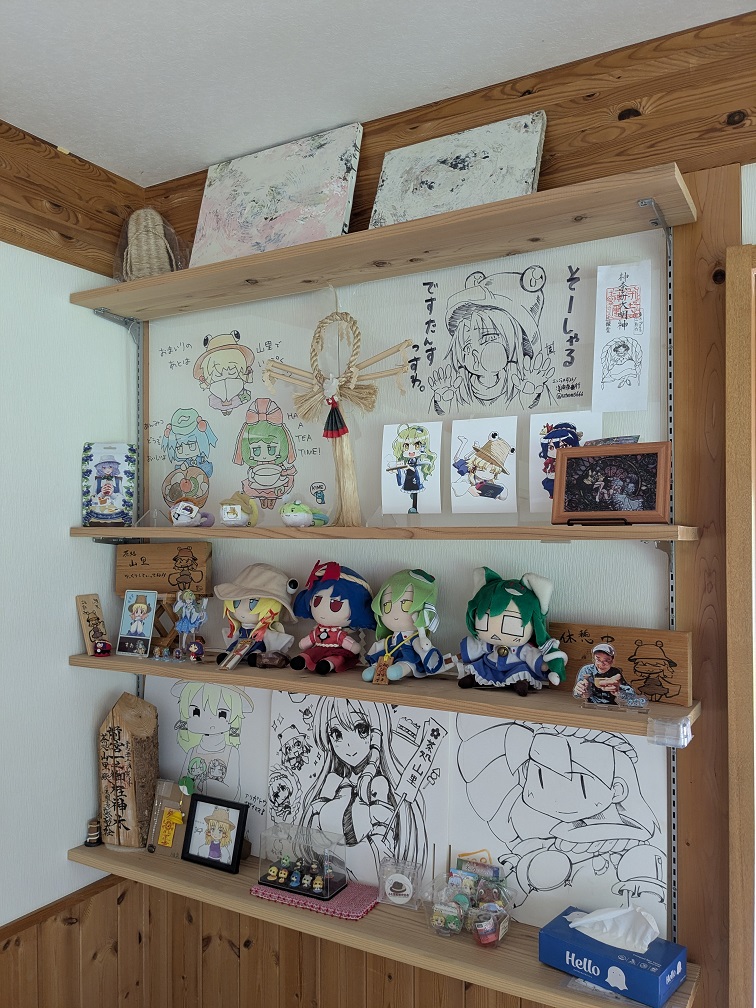
There is a cafe near Suwa Taisha Maemiya that has not only delicious food and drinks, but also strong presence of Touhou fan goods.
It is an extremely interesting meeting point of old and new sacred geography, of pilgrimages and otaku pilgrimages.
The journey so far has taken us through an analysis of Shinto, Buddhism and Taoism and their influence on Japanese culture and Touhou. Taking a look at these three traditions separately is however only half of the picture. Shinto was influenced by both Buddhism and Taoism. When Buddhism arrived into Japan, the way it became expressed was influenced by local traditions. Before this local influence, the forms of Buddhism that arrived in Japan had also been influenced by Chinese traditions. Taoism did not exist as a separate mass religion, but rather as a broad, diffuse influence that influenced Japanese culture and spirituality. Certain aspects of Taoism were also picked up by Buddhists.
So rather than sharply distinct traditions, it’s much more truthful to see these three as currents which have at times crossed over into each other, while remaining distinctive. This process of intermingling would at times lead to the emergence of mixed, syncretistic practices and movements that would acquire their own identity. These include onmyodo and shugendo, but also a great number of later religious movements. The later religious movements have not had much of an apparent influence on Touhou (except perhaps cultivating cynicism towards organized religion in ZUN), and they are mostly out of the scope of this section.
The rather syncretistic spiritual landscape of Japan has also been influenced by other things besides the native traditions that became Shinto, Buddhism and Taoism. A notable influence that is not quite directly referenced to in Touhou is Confucianism. While Confucian influence can be seen as beginning from the start Chinese influence of Japan, especially the Shogunate favored rationalistic Neo-Confucianism. It has been represented that a common formula of fiction from that era, of calm, collected, stoic samurai dealing with unruly spirits reflected a kind of Neo-Confucian ethos of men taming the irrational, dangerous and uncultivated. The historical Prince Shoutoku was also apparently influenced by Confucian ethos, and Toyosatomimi no Miko’s drive to become the administrator of the Human Village seems to reflect this aspect of Prince Shoutoku.
If Confucianism believes in a transcendental moral order that ensures a proper society, Touhou believes in a curious belief-driven ontology. The type of characters that Touhou highlights are anything but stoic rationalists, and it seems to highlight the types of characters and entities that would have been at the receiving end of a blade - or entirely written out of - Neo-Confucian fables. I would not go so far as to say that Touhou is anti-Confucian, but it does seem to live on the other side of Confucianism’s influence on Japan. A truly comprehensive understanding of the spiritual history of Japan would require studying the influence of Confucianism, and such would not be a wasted effort for those interested in it.
Japanese spirituality has also been slightly influenced by Christianity and later Western spiritual movements. These ideas have mostly been relatively fringe, but at times Japanese culture has taken elements of Western spiritual traditions and made them their own. While the idea of a supreme deity exists in certain Chinese traditions, Japanese religious movements incorporating this idea seem to have gained prominence only after contact with Christianity. Christian imagery influenced some Japanese depictions of hell, and through that perhaps Touhou’s hellish realms. The Spiritist movement of the late 19th century influenced Japan, and Touhou has a reference to these influences in the form of the kokkuri-san divination game referenced to in Forbidden Scrollery.
Later Japanese new religious movements have been influenced by Western New Thought and New Age movements, and there are a number of Japanese people interested in Western occultism. When it comes to these influences, Touhou is an interesting case. Most references to Western occultism in Touhou are rather surface level, but some of ZUN’s broader worldbuilding ideas are extremely resonant with ideas from actual Western occultism. These include the power of belief to shape reality, as well as “quantum” explanations for magic. Whether these are a form of cultural convergence or influence from Japanese interest in “okaruto”, occult in the sense of all kinds of magical, mysterious and strange things be they foreign or native, is very hard to say. Exploration of these themes is also mostly out of the scope of this section.
While Japanese syncretism has been to some extent explored in the previous sections, this section attempts to bring together the three traditions so far explored and their syncretic offspring back into a whole. What Buddhism intermingled with, from what Shinto was born out of and what Taoism was assimilated into is ultimately a nameless “native faith”, indigenous spirituality deeply tied to concrete sacred locations and the lineages of people dwelling there. This “native faith” was also deeply involved with what we would call shamanism, the process of interacting with the spirit world through intermediaries using trance states. Over the course of history, the central political power tried to regulate this, culminating with the Meiji ban on spirit mediumship. Shamanistic practices nevertheless persist to the fringes of Japanese society up to this day. Shamanism also influenced certain forms of Japanese arts, notably noh theater.
By exploring this rich territory, we are able to see Touhou as a distant continuation of some truly ancient features of Japanese culture. Its rich corpus of references encompasses Japanese spirituality in near totality, and the vast network of references to real world sacred places crafts a kind of sacred geography of its own for Gensokyo. Touhou has also turned certain sites that did not previously have a particularly strong spiritual charge into destinations of kind of otaku pilgrimages. Gensokyo’s own spirit world geology also acts as a kind of sacred geography that replicates spirit realms from Japanese traditions. Touhou deals with many topics related to traditional Japanese shamanism, such as various spirits and possessions and exorcisms. One can also see the protagonists as representing various spirit guides or psychopomp archetypes. Last but not least, ZUN has given some indications that his creative methods might be closer to shamanism than one would assume.
Syncretism
Syncretism is a term from Western study of religions and traditions. In its broadest meaning, it refers to any combining or merging of ideas. When it comes to religions and traditions, it can refer to things like assimilation of beliefs or practices from faith to another. Another form is recontextualizing beliefs, practices or deities into a new context. A very classic example from the West is how Romans tended to interpret deities from other cultures to be the same as ones from their own pantheon. This allowed various conquered cultures to keep their aspects of their traditions while being assimilated to a larger imperial tradition.
While syncretism is a term that emerged in a Western, it has also been used to describe non-Western developments in traditions and religions. Some have criticized this tendency, and it’s true that there have been notable differences in how the Eastern religions have exchanged ideas and practices. The social contexts and political systems of West and East were traditionally rather different, and this also influenced this process of exchange. I however find the term to be applicable, as there are rather clear parallels between the West and East in some respect. For example, it has been argued that part of the formation of the imperial Japanese mythology was the assimilation - and subjugation - of local deities as kunitsukami into the mythology. This kind of element of power can also be found in the process of kami becoming seen as manifestations of buddhas and bodhisattvas, as it was an example of a more powerful paradigm finding ways to assimilate popular beliefs.
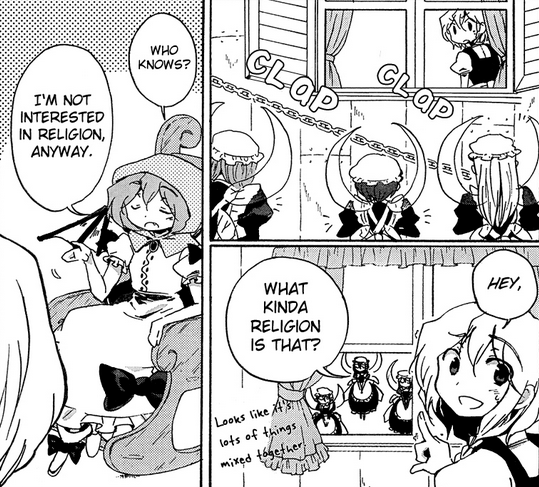
Touhou itself occasionally comments on syncretism.
This element of power is important for understanding the process of syncretism. For there to be need for syncretism, there needs to be contact between two different traditions. And more often than not, some kind of power struggle will emerge from this. However, there are also other dimensions to syncretism. Often it seems that the syncretic process starts to take on a life of its own. For example, the rise of onmyodo prominence might have been partly spurred on by people seeking a counterforce to the influence of Buddhism. The calendrical, astrological and - if you believe in such - spiritual talents of those practicing onmyodo however greatly contributed to its legitimacy and rise in power. And once its ideas escaped the palace walls as times changed and imperial patronage was no longer forthcoming, its influence took on a life of its own. When it comes to Buddhism, one can see the various manifestation theories as part of a power process, but they are also an earnest evolution of Mahayana beliefs in how everything has the enlightened nature in itself. It was this Mahayana belief that caused Japanese Buddhists to approach the local traditions in a way that was radically different from how Christianity treated the native faiths. It has been said that there is a kind of profound animism in Mahayana Buddhism, which readily meshed with the local beliefs and practices in Japan.
There is an organic side to syncretism which is related to what is called folk religion or vernacular religion in religious studies. Vernacular religion can simply refer to the popular forms of how religion is practiced, but it can also include elements which diverge from religious doctrine, authority or practices. Generally speaking, before modern times, there was an enormous gulf of understanding between the literate upper classes and the nonliterate lower classes. Even in cultures where there would be a “religion of the book”, much of the population would have not understood the finer points of religious dogma. As such, folk religion was lived practices and beliefs. Sometimes this included holdovers of previous traditions. In much of Europe, remnants of pre-Christian practices and beliefs lingered so long it was more industrialization than Christianity itself which eventually caused them to vanish, and even then this process wasn’t fully complete.
The development of Japanese vernacular religion is related to how “organized” religion was for a long time an elite affair. Early on Buddhism was something practiced in the imperial court and by nobility, to the point where some have called early Japanese Buddhism essentially a form of elite wish-fullfilling magic. When Buddhism started to become popularized, people would have struggled to understand the hyper-literate and foreign faith. So popular forms of Buddhism emerged where the various Buddhist figures were seen as potent deities and its practitioners as powerful exorcists who could deal with troublesome spiritual powers. There is a rather curious parallel here with another mountainous country, Tibet. Tibetan Buddhist mythology explicitly describes a process of taming the local spirits by the legendary founders of Tibetan Buddhism, Padmasambhava. This process was however imperfect and therefore requires constant renewal. While Japanese Buddhism does not explicitly have such a grand mythology, the element of taming unruly spirits was certainly present. Before kami were regarded as manifestations of enlightened beings, they were thought to be in need of salvation.
Buddhism was not the only religion in Japan that found local interpretations among the people. What is modern day Shinto is a composite of numerous local traditions and the imperial Yamato mythology. At times people would put their own spin on the Yamato mythology.Examples of this are people around Minakamiyama regarding this mountain as the site of Amaterasu Oomikami’s hiding in the cave, or kappa mythology from Fukuoka where a kappa deity saved Izanagi from drowning while he was committing his first misogi. In Japan, there are innumerable local variations of beliefs, practices and legends which could fit under the umbrella of Shinto. New forms of religion and new beliefs were not just something imposed from above, but also something that offered local people either new forms of spirituality they found appealing, or offered new contexts for local beliefs.
Beyond these factors, there are two elements to syncretism which I would call the experiential dimension and “fascination with cool things”. The experiential dimension might be a bit difficult to understand for people coming from Western culture, where “belief” is a big part of religion as most know it, and contact between other religions is fairly minimal. To put it simply, one does not have to believe in anything to experience something when coming in contact with religion. Even an atheist can find a church to be beautiful. I have rarely referenced my own experiences while writing this, but here I will make an exception. Climbing up Mt. Inari, emerging from the dark tunnel below Zenko-ji exactly at midday to hear the temple bells ringing, seeing Suwa Taisha Maemiya up close and taking part in a goma ritual were all extremely powerful experiences for me. I think they would have been for anyone who could suspend the desire to browse the smartphone for 10-20 minutes, even if they didn’t believe in spirits or gods or anything like that. The Eastern faiths are more practice-oriented than faith-oriented, hence the kind of experiential dimension that emerges from practice is important. I find it hard to believe that someone could sit through an 80 minute zazen session and do the three bows and four vows and not be stirred in any way. At least you’d feel catharsis from powering through boredom.
Before modern information and entertainment saturation, coming in contact with something like a monk chanting fervently would have been a tremendous experience. It still is, but it’s hard to put yourself into the mentality of a pre-medieval Japanese peasant hearing a sutra recitation for the first time. Humans are meaning-making beings, and experiencing something forces you to put this experience into a context. Syncretism is partly a way to contextualize the fact that many different faiths and practices can cause many different, yet similar, powerful experiences. What these experiences are or mean, is ultimately for everyone up to themselves to figure out. Premodern Japanese would have for the most part interpreted them as part of a numina-saturated world and as experienced reality.
The last factor, that “fascination with cool things” is related to another experiential dimension. A substantial part of humanity has always been curious and fascinated with novelty. The ability to face new circumstances and to adapt to them is likely the single most important reason why our species has spread to every continent and biome of this planet. Some have always been xenophiles, driven by novelty and seeking to break with tradition. No doubt these types of people would have always been the ones to first consider the merits of new traditions when they became exposed to them. There are also all kinds of extra-spiritual qualities to these traditions. They carry authority, sometimes novelty, a particular sense of aesthetic and a particular message. They can be a new thing, an interesting thing to come in contact with, to experiment and toy with. Some people interested in spiritual topics become enraptured by an endless loop of novelty these days, but this aspect would have also been present in the past. There have been all kinds of spiritual fads and manias in both the West and in the East. While not all of them led to syncretic processes, sometimes they did. While the emergence of the wandering hijiri who popularized Buddhism in Japan was no doubt triggered by a serious cause, one can also see it as a kind of a cultural trend too.
Japan’s syncretism isn’t exceptional in the East Asian context. When it comes to China, the most practiced form of religion is a nebulous folk religion of Taoist, Buddhist and Confucian influences. Korea, China and Japan all have various post-Western contact religious movements which have even managed to syncretize Christian influence with local beliefs. When it comes to Japan, it’s perhaps simply that the attempted division of Shinto and Buddhism ultimately ended up paradoxically highlighting the syncretic elements of Japanese religions.
In certain cultures, the folk or vernacular religion has elements that could be said to be shamanic in nature. Japan is one of these cultures, and these shamanic aspects used to be rather prominent in the past. Understanding the full picture of Japanese spiritual traditions requires understanding this shamanic layer, which has potentially truly archaic roots.
Shamanism
Shamanism is a somewhat controversial term. It has been defined as a spiritual practice where the practitioner interacts with the spirit world in an altered state of consciousness. There are various methods for achieving this state, such as singing, dancing, chanting, drumming, fasting, exposure to cold or the consumption of entheogens. The purpose of interacting with spirits can include things like healing, divination, helping in hunts and communicating with ancestors. Generally speaking an animistic worldview underpins the shamanic practices. Spirits are thought to exist, to be in many different things, and that they can have an influence on the world. The roles of what are called shamans vary from culture to culture, and can also include things like having knowledge of medicinal plants, acting as mediators in the community and preserving and passing on traditions and mythology. An ecological role has been observed in some societies, where the shamans appear to guard against excessive hunting and depletion of natural resources. Some shamans can be conceptualized as intermediaries between humans and other beings, be it spirits or animals.
In many cultures, healing was an important part of what the shamans did. In many cultures, there exists an idea of a shamanic sickness. This means that shamans were either marked at birth by particular qualities like birthmarks or a certain kind of dispositions, or that they went through a life-altering illness that could be conceptualized as a kind of death and rebirth. Sometimes it was thought that this process would allow the shaman to understand sickness and therefore be able to cure, and sometimes it was seen as a profoundly transformative process. This could be things like spirits tearing the shaman apart and replacing their organs with new ones, turning them from an ordinary human into a shaman.
As shamans were and still in certain societies are seen to be extraordinary beings, they often hold a role that was seen as being apart from the rest of the group, yet still part of it. This othering would give them spiritual authority, but sometimes it would also manifest in negative forms. Sometimes shamans are treated with fear and suspicion, suspected of being able to also use spirits for cursing. Some cultures have distinctions between healers and kind of "sorcerers" who are wicked shamans who use curses to harm people. As such, spiritual battles between shamans can be part of shamanism.
Some researches suggest that the origins shamanic practices might be truly archaic, dating to the paleolithic era. This would make shamanic practices tens of thousands if not millions of years old. It’s of course difficult to be certain of such, as any evidence for these kinds of archaic origins relies on interpretations of burial sites, cave paintings and the idea that certain peoples traditionally associated with shamanic practices were closer to prehistoric humans than the modern West. The latter has been criticized especially strongly, and it’s very unlikely that any currently existing shamanic tradition is a direct continuation from the paleolithic, but has evolved over time.
The word shamanism comes from the word shaman, which comes from a Tungusic language, a family of languages spoken by various Siberian peoples. The exact etymology of this word is somewhat debated. A common theory is that it’s derived from “to know”, but others have questioned this. Some have pointed out the similarity to Sanskrit word sramana, which means a wandering holy person. Since Buddhism reached the Central Asian, Mongolian and Siberian areas where it overlaps with local shamanism, some think this is the true origin of the word. Whatever the exact etymology or origin is, the term shamanism was originally used to describe the practices of Siberian peoples. Later on the term has become more generalized to mean a rather wide variety of practices done by many different groups of people.
One important figure in this broadening of meaning was the scholar of religion Mircea Eliade (1907-1986). He is considered to be one of the most influential scholars of religion of the 20th century, and he worked with a wide variety of topics. His core ideas include the division of the sacred and profane, the idea of eternal return, the center and the world tree and theophany, or the appearance of the divine in the world. Eliade saw the sacred as something that stood apart from profane things, and which represented a return to a truer form of existence. He thought that many different rituals reflected a kind of “eternal return”, reliving events from mythology which structure the world. An example of this would be new year’s celebrations in Ancient Egypt reflecting the creation myth of the world. Eliade thought that for the prototypical religious person of the ancient world, the sacred represented everything worthwhile in the world. The place where the sacred would manifest would become a kind of spiritual center for these people, and turn into a kind of ordering principle Eliade thought that the various world tree mythologies reflected this. This process of the sacred manifesting in the world was called theophany by him. Eliade also noted that in many traditions, the sacred was described in terms of an union of opposites, something that would be wonderful and horrifying, creative and destructive.
Eliade’s major contribution to the study of shamanism was his book Shamanism: Archaic Techniques of Ecstasy. Published in 1951, it was the first attempt at situating shamanism in the context of world religions. Eliade saw shamanism as “mysticism, magic and religion” in the broadest of terms, and as a technique for achieving religious ecstasy. He argued that the term shamanism would not encompass all “magicians” or “medicine men”, but that it wasn’t a phenomenon unique to Siberian peoples either. Eliade proposed several different definitions for shamanism, but favored simply it being a “technique of ecstasy”, or an altered state of consciousness as we would call it these days. According to Eliade, the shamanic worldview sees that there is a spiritual connection between everything in the universe. This connection could then be used to contact spirits and aid others using a variety of techniques reaching an altered state of consciousness.
While Eliade’s work in the study of religions and shamanism was influential, he has been later criticized for overgeneralizing and lack of empirical field studies. Later on, his approach inspired even more controversial takes on shamanism in the West, which led it to transform from a subject of study to a form of practice associated with New Age communities. The work of Michael Harner (1929-2018) was instrumental in this process. He did ethnographic studies among the Jivaro and Conibo people of South America in the 1950s and 1960s. With the Conibo, he ended up taking part in ayahuasca rituals. After returning to the United States, he began experimenting with monotonous drumming as a technique of reaching an altered state of consciousness. Harner began developing what became known as Core Shamanism, a form of shamanism stripped of its cultural ties. This later influenced the Western neoshamanic movement. Both Core Shamanism and neoshamanism have received a lot of critique for things like cultural appropriation, exploitation of indigenous cultures and overgeneralizations. An example of overgeneralization in Harner’s work is the claim that shamanic cultures universally have a three-layered cosmology of a lower, middle and upper world. While these sort of conceptualizations do appear in many cultures, curiously enough they do not appear in the cultures Harner himself studied.
Later scholarship has sought to treat different cultures more on their own terms, and some have been very critical of applying the term to for example Native American or African practices. Other scholars have sought to understand the emergence and persistence of shamanism, both in its old and new forms. One example of this is Michael Winkelman’s neurotheological theory. According to Winkelman, shamanism brings very real benefits to the practitioner and the communities they are part of. These benefits come from an integrative process of cognitive change which is triggered by the altered states of consciousness that shamans go into. This integrative state allows communication between mental systems that do not normally communicate. This allows for heightened social intelligence and understanding of nature, which allows shamans to provide service for their community.
Some researchers however are more doubtful on the benefits brought on to the practitioners and their communities, and see them as being more incidental than anything else. The “subjective” or “by-product” model of anthropologist Marvin Singh is an example of this. Singh sees shamanism as a kind of “hacking” of human biases, wishful thinking and power of suggestion, using (or exploiting) the human desire to control uncertainty. By othering themselves and presenting themselves as extraordinary beings, shamans are able to convince people that they can control uncertain events like hunts or illness. Interestingly enough Singh expands his view of shamanism vastly outside of what many would consider shamanism. In his book Shamanism: The Timeless Religion (2025), he uses people working in Western medicine and finance as examples of people working with this kind of “shamanic” mode per his interpretation along more conventional shamanic figures.
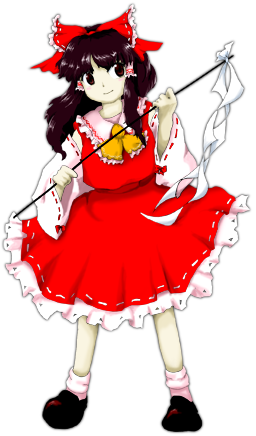
Hakurei Reimu is not only a more shamanic variety of shrine maiden with her exorcisms, she is also a type of "belief hacker" at times.
The term shamanism has also been used to describe certain practices found in Japan. An important figure in the study of Japanese shamanism was Carmen Blacker (1924-2009) who spent time studying mediums, exorcists, ascetics and members of new religious movements in Japan. In the opening to her book The Catalpa Bow (1975) she states she was following the “custom of Japanese ethnologists” by calling these people shamans. So certain Japanese scholars themselves saw similarities between shamanism and particular aspects of Japanese culture. Considering that there are apparently genetic links between Ancient North Eurasians and the very oldest layers of Japanese population, the Jomon people, it might be that some very archaic shamanic practices arrived to Japan along with its first human inhabitants. Blacker herself considered the various forms of Japanese shamanism a survival of a very old layer of Japanese culture. If we use the definition that shamanism is spirit work done through an altered state of consciousness, it certainly fits some Japanese mediumship and ascetic practices. There are also parallels between certain other aspects of Siberian and shamanism as well as old Japanese culture, starting from a broadly animistic worldview and ending with finer details such as mirrors having a function as sacred items in both Japan and certain Siberian cultures.
The shamanic practices in Japan did not form a single organized religion. Rather they were intertwined with folk religion, Shinto, Buddhism and their syncretic manifestations. The traditional figures involved in Japanese shamanism were the medium and the exorcist. Mediums went into trance states to communicate with spirits, and exorcists communicated with unruly spirits in order to make them cease their troublemaking. Most commonly women were mediums and exorcists were men. Often the exorcists would use mediums in their work, letting spirits communicate through the medium. Sometimes this relationship went beyond work, and marriages between these two types were fairly common. That is, when the exorcist wasn’t a Buddhist monk.
A particular feature of Japanese mediumship is how often the choice of reaching an altered state of mind was extreme asceticism. Many Japanese shamans engaged in remarkably austere lifestyles and extreme ordeals. These included things like cold exposure, water purification, extended mantra recitations, abstaining from certain types of foods and living as a hermit. There appeared to be a rather direct correlation between how involved in austerities one was in and how spiritually powerful they were perceived to be. While some no doubt would like to dismiss this as a kind of process of “othering” a la Singh - and perhaps there is such an element to it - there does seem to have been some kind of genuine dimension to this. Blacker details cases where people became slacking in austerities and could not engage in spirit mediumship any longer. The mediumship failed, wrong kinds of spirits appeared or then members of the audience became possessed instead.
At the very least, based on descriptions proved by ethnologists, the extreme austerities seemed to have granted those practicing them remarkable powers of spirit trance. These include the ability to enter a trance state extremely quickly. Based on historical descriptions, the trance states could be quite the physical ordeal. There are descriptions of people gripping wooden wands so tightly that they became impossible to remove from their hands. In a deep trance, people were unresponsive to pain and sometimes had pulse so faint it was almost impossible to detect. There was a strong bodily dimension to Japanese shamanism, including various rituals that featured seemingly impossible physical feats. These included walking on coals, splashing oneself with boiling water and walking up a ladder of blades.
The history of Japanese shamanism was of course not without its fakes and frauds. It should indeed be noted that the Japanese did not believe all spirit possessions and instances of trance were legitimate, and developed methodologies for sussing out fakes. Partly this was based on how the medium carried themselves, and the accuracy of information given in the trance state. The more wilder, harsher and less human the medium appeared, the more legitimate and powerful they were thought to be. The long-bearded, long-haired and wild-eyed mountain hermits that were hard to distinguish from Tengu seemed to enjoy particular reverence. Since the mediums were expected to answer questions, being able to give accurate information was of course regarded as a sign of a legitimate medium. For example, if expectations regarding the recovery of a sick family member were too divergent between the medium and the family, a medium could be seen as a fraud. There were also some more direct methods, including sticking needles into the soles of feet of those in a trance. If the trance was considered legitimate, the medium wouldn’t even flinch. So the Japanese of previous eras were not gullible when it came to shamanism, or at least authentic trance states.
The kind of drum trances that people would have been involved with in Siberia don’t seem to have been prominent in Japanese shamanism during recorded history. Traces of this can still be seen though. An example of this comes from Japanese mythology, where the racket that Ame no Uzume no Mikoto causes with her wild dance on top of an overturned pail can be seen as a way to create a kind of drumming using her own body. Drumming is used to accompany modern day kagura dances. It’s thought that these used to be a considerably wilder affair. This is referenced in Touhou this is referenced to in Reimu’s “Wild Dance” spellcard from UFO. Another instance where drumming can be found in spiritual context are many Buddhist rituals. While Buddhists would not probably conceptualize what they are doing in shamanic terms generally speaking, there is certainly a trance-like quality to some of the Buddhist rituals. There is also a case to be made that the repetitive chanting of mantras can perhaps act as a similar audio trigger as drumming. Another example of a repetitive sound being used to reach a trance state is the titular catalpa wood bow, a single string instrument, that Blacker described. Certain mediums used to pluck it to create a droning sound while chanting.
Another aspect of Japanese culture that is related to shamanism and drumming is the Noh theater, which features the use of drums alongside flutes and chanting to provide an aural element to the act. It’s said that the drums represent waves and the flutes represent winds. Noh is thought to be a survival of an older form of shamanic practice, and noh retains this type of element to it up to this day. Noh plays feature various spirits as characters of the play, and the context they are presented in tends to be ritualized.
Some Noh plays retain a very explicit spiritual dimension. These include the Okina, in which the mysterious titular character, “Old Man”, brings blessings to all beings. This character has sometimes been interpreted as a kind of stand-in for all ancestral kami. Before performing the play, the actors abstain from meat and sex for a week and undergo a purification ritual. This is similar to the regimen undertaken by Shinto priests in certain contexts. In an NHK documentary about the play, the actor who portrayed Okina described going into an altered state of consciousness while performing the play. So Noh retains some of its shamanic potency to this very day. Touhou of course has references to Noh in the characters of Hata no Kokoro and Matara Okina.
The non-human world that the shamans interacted with included things like ancestor spirits, deities and certain youkai. It was thought that certain types of spirits could possess unwilling people and cause problems. The kitsune in particular were thought to be prone to possessing people. Mediums could reach out to the ancestor spirits in order to communicate their will to living relatives. It was thought that these spirits could cause problems for those who didn’t heed their desires. Sometimes local deities were invoked through mediumship. The Japanese tended to take anything involving the kami rather seriously. A common way for one to begin their journey into becoming a medium or exorcist was the occurrence of a reimu, a divine dream where a deity would appear to them. They could lead them to do things such as undertaking particular pilgrimages.
There is also an aspect of shamanic sickness to Japanese culture. Especially among those mediums who ended up being central figures on certain new religious movements there were people who had been sickly or feeble, but had undergone some kind of cathartic experience and came back changed. Resolving their issues granted them what at least their followers considered extraordinary abilities like mediumship and healing.There were also people who ended up becoming shamans who did not have quite as dramatic experiences, but who did come from some kind of a desperate background, “surrounded from eight directions” as the Japanese idiom goes. One can also see the various extreme forms of asceticism as a kind of way for inducing a shamanic sickness. Some people were left permanently physically altered from the practices, such as finding it difficult to digest certain foods after extreme fasting.
Spirit mediumship, shamanism and exorcism are things that do not exist in a vacuum, but are subject to social conditioning and control. This goes for Japan too. Beyond various communities having their own means for rooting out fakes, the Japanese government and religious authorities would intervene in these matters from time to time. The earliest known attempts at controlling shamans go back to the year 645, when the Japanese officials made practicing mediumship illegal among commoners. Further attempts at controlling the mediums were made over the next century. Being a miko, which meant more of a shamanic role, was first restricted to women. Then an official system of shrines was established, and then the privileges of miko were stripped away, and in some cases they were exiled from their communities. Buddhism too tried to suppress the miko, but at times the Buddhist institutions also worked from them. Over time the miko became the shrine maidens we know today. The most extreme example of the control of shamanic practices in Japan was the Meiji ban on “superstition. So while shamanic practices formed part of the traditional communities, they were clearly perceived as having disruptive potential by the social elite.
As shamanism works as an intermediary between the human social world and other worlds, some kind of ideas regarding the spirit world appear to be invariably part of it. While these ideas cannot be generalized to the extent as some past scholars have, one can indeed find some commonalities across different cultures. When it comes to Japan, their ideas regarding the spirit world are rather complex, and at times contradictory, reflecting the several different cultural layers that make up current Japanese culture. We will be looking at these ideas next.
Sacred Geography
Sacred geography is a term from the study of religions. It refers to the intermingling of geography and the sacred. The study of sacred geography can include things like the study of sacred sites and phenomena related to them, like pilgrimages, but also things like how geography manifests in religion and mythology. Religions and spiritual traditions tend to have a kind of cosmology of their own. Often the physical and the mythological become deeply intertwined. Sometimes the mythological cosmology is thought to also manifest in the everyday human world. Sometimes the mythologies refer more straightforwardly to places existing in everyday reality. So while it’s always some particular quality related to mythology, religion and the numinous that makes a site sacred, sometimes it goes beyond a site being a place of worship or of historical importance.
There’s been various approaches to the study of sacred geography. Mircea Eliade wrote of his idea of hierophany in relation to sacred places. To Eliade, sacred places are places where a kind of breach or disjunction between various layers of levels of reality have in some sense occurred. This breach allows a two-way communication between this world and the others. In Eliade’s schema, these worlds are the heavenly upper realms and the chthonic lower world. Sacred places allow those who choose a kind of active form of seeing to access the numinous side of reality and exceed the limitations of historical time and physical space. It’s entirely possible to treat this in cultural and psychological terms. To Eliade however the sacred wasn’t just an abstract thing, it was something that has an agency. It seeks to take a form. It might manifest in many different forms, as parts of the sacred site, living things or in visions and apparitions. So just as humans might use a sacred site to access the numinous, the numinous may use sacred sites to access humans. This agency of the numinous seems to transcend any particular interpretations humans place on it. Many sacred sites have remained sacred throughout the ages, even if the religions practiced there have changed. In Europe, there are neolithic sites of worship in which people have later reported Marian apparitions. Many churches were built on sites of older religions and mystery cults. In Japan, Buddhism made its way to mountains and lakes that were most likely revered far before it reached the shores of Japan.
Eliade wrote of the archetype of the axis mundi, world pillar or world tree as a kind of ultimate, most basic manifestation of a sacred site. The world tree is a structure which binds together the various lower, middle and upper realms, and allows one to travel between the various realms. He saw that various sacred sites that either were or mimicked the forms of trees, mountains and pillars were manifestations of this archetype. Many sacred sites do fit into these categories, especially if one sees tower or pagoda-type structures as representing the axis mundi. To Eliade, this kind of structure represented the divine, natural structure of the universe itself. When the axis mundi structure makes itself known through hierophany, it creates the breach that makes a place sacred. Sacred places give structure and meaning to the world for those who believe in them. Sometimes a place in which Eliade’s terms would manifest the world pillar becomes a kind of literal center of the world, against which everything else is referenced to. If one is to look at this in less grandiose terms, local places of worship were - and to some still are - important in structuring everyday life. In Eliade’s view, the sacred center was often surrounded by a chaotic world populated by monsters, ghosts, demons and foreigners identified with such creatures. Thus the axis mundi serves not only a division between the profane and sacred, but also “us” and “them”. While Eliade’s ideas regarding the axis mundi have been criticized as overgeneralizing, many mythologies do feature very literal world trees, and others feature similar structures in other forms.
Whether one wishes to put faith in Eliade’s views or not, for the believers sacred places stand apart from mundane ones, thus a division between “there” and “here” exists to them. There are certain ways one should conduct themselves in a sacred place. These include various norms, rituals and taboos. This division between “there” and “here” creates a boundary between these, and therefore a liminality. In turn, this liminality creates a kind of tension, sometimes a very palpable sense of crossing over. Sacred places can in itself be viewed through the lens of liminality. They are places, but they are also something more, a bridge between the human world and the world of mythology and history, and for those who believe in such, the divine and the mundane. While this kind of element can be found in all spiritual traditions to some extent, it seems particularly prominent in Japan. Sacred sites have literal gates and rope enclosures that mark the division between profane and sacred territory. The kami are thought to manifest in physical things, yet they are not physical things. More broadly, it was thought that the spirits were most manifest during the twilight hours of evening, between day and night.
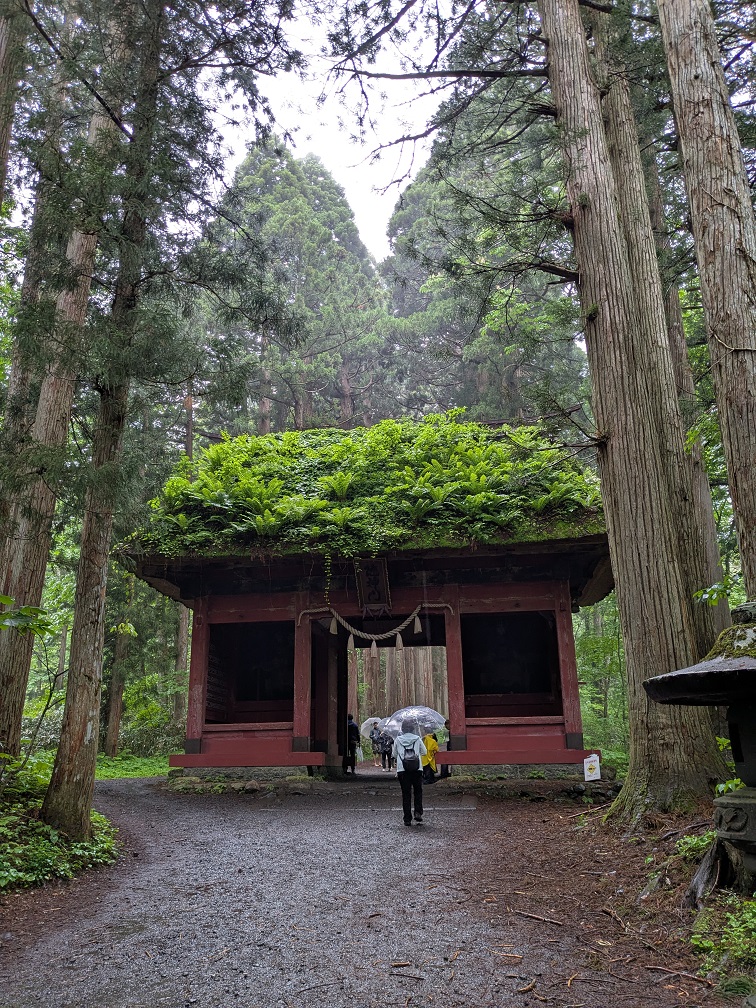
A gate before the last stretch of the Togakushi shrine pilgrimage, an example of a structure dividing profane and sacred, "here" and "there". One of the shrines at the Togakushi shrine complex is dedicated to Yagokoro Omoikane no Mikoto, making this also a pilgrimage site to some diehard fans of Eirin-sama.
A concept related to liminality is that of a non-place. It’s a term coined by the anthropologist Marc Auger. In his definition, a non-place is a space of transience that humans do not permanently inhabit, where they remain anonymous and which do not in an anthropological sense hold enough significance to be considered “places”. His examples included motorways, supermarkets, hotels, and airports. A “place” in an anthropological sense is one where people meet others, where social exchange is facilitated and which reinforces people’s identity. As Auger’s idea is related to places associated with modernity and stands against the kind of identity-formation processes many associate with sacred sites, it might be surprising that his ideas have been applied to the study of sacred sites in Japan. The non-places represent a kind of extreme, prolonged form of liminality. Certain Japanese ascetic practices feature people going to places regarded as being manifest in both the human world and the spirit world. The ascesis becomes a process of suspending one’s everyday identity and dwelling in a transitional, liminal state. Perhaps this extended liminality then can allow something to crack open and for a hierophany to occur. One could also apply this idea to pilgrimages, which also feature a break from everyday life along with travel and the kind of facilities and non-places Auger wrote about.
A concept related to non-place is Mark Fisher’s non-time. Fisher’s idea came from a view of cultural studies, where he observed that popular culture lacking local flavor was standing outside both of place, but also increasingly out of time. Some recent developments, such as the fad of nostalgia for the 1980s seem to have vindicated Fisher’s ideas regarding popular culture. However, when one thinks of things that are of indeterminate time, Eliade’s idea of eternal return and sacred sites referencing a kind of timeless time springs to mind. So perhaps it’s just not traveler’s facilities of modernity that create non-places, or flattened global popular culture that creates culture of non-time, but also things many would consider rather “elevated” compared to those. The popular culture of the 20th century might have been an anomaly in a world where large aspects of “culture” used to be something that could be passed on for hundreds if not thousands of years with rather incremental change. It might be strange to consider both an airport lobby and a shrine to be kind of no-places of no-time, yet if one takes the view that the sacred is manifest in the world, it becomes less strange. And those with keen eyes can unravel the non-places, discover the particulates of hotels, airports and motorways that situate them in wider reality, and unpack the particularities of the waves of global pop culture which situate and date them.
The study of sacred geography is important for understanding the spiritual traditions of Japan. This is because Japanese spirituality and religion are deeply bound to sacred sites. Shinto has an essentially animistic worldview. Various natural phenomena and sites are considered to be places where kami make themselves known. It’s believed that in the earliest forms of native Japanese religion, there were no shrines, but rather various natural objects that were considered sacred, such as trees, mountains and waterfalls. These days Shinto of course has sacred sites constructed by humans, but these too were built in places where the kami were thought to manifest or choose in the natural world. For example, the shrine complex at Ise is built where Amaterasu Oomikami is said to have chosen it herself.
Shinto also has a mythological cosmology that however intersects with places found in this world. A famous example of these intersections include the Ama no Iwato, the cave where Amaterasu Oomikami hid herself. One can find an enshrined cave in Takachiho at Kyushu which is said to be this very cave. Another example is the hills of Yomotsu Hirasaka, where Izanagi fled from Yomi. These hills can be found in the Shimane prefecture, and the entrance to Yomi is thought to be there.
The underworld of Yomi is part of the mythic cosmology of Shinto. It’s a dark underworld of the dead, but the Shinto ideas regarding afterlife go beyond Yomi. There’s also Ne no Kuni and Toyoko no Kuni. Ne no Kuni, literally “Land of Roots” is also regarded as an underworld and is sometimes thought to be the same as Yomi. Tokoyo no Kuni, “Everlasting Land” is an otherworld populated by various kami and spirits of ancestors. Sometimes this place was thought to be beyond the seas. The relationship between these places is unclear, and they are thought to reflect a blending of ancient Polynesian and Eurasian ideas. There is a geographical divide in beliefs that reflects this division in beliefs which persisted at least to the mid 20th century. People in the coasts were more likely to regard the afterlife as being beyond the seas, while people inland more commonly believed in chthonic realms or that spirits of the dead go into the mountains.
Mountains are generally regarded as sacred sites, home to kami, in Shinto. There is an old layer of mythology where the kami of the mountains, equated with ancestors, come down from the mountains during spring and turn into the kami of rice, and then return into the mountains in autumn. There are also mountains that are associated with deities that have broader faiths and cultural importance associated with them. The most famous example is Mt. Fuji, thought to be home to the kami Konosakuyahana-hime. Mythology related to this kami appears in creation legends, and is used to explain why humans have such short lifespans. Another famous sacred mountain is Mt. Inari, where it’s said that the different aspects of Inari Ookami dwell. It serves as the spiritual center of the Inari faith. Mt. Moriya is an example that is very closely related to Touhou. It’s considered the goshintai, the “body”, of the kami of Suwa Taisha Honmiya.
Shinto creation myths describe a world explicitly split into two, either a Chinese influence or something reflecting a deeper, shared root. The light elements floated upwards, and heavy elements settled downwards. This created the heavenly realm and the earthly realm. The heavenly realm is called the Takamagahara, “Plain of High Heaven”. It’s where the heavenly amatsukami dwell. Much of Shinto creation mythology describes the process of amatsukami coming down to earth to pacify and perfect it. This process can be read in several different ways - one reflecting the historical expansion and conquest of the Yamato people, as a fiction intended to justify the imperial system or as reflecting something more archetypal. Certainly the struggle between “higher” civilizational forces and unruly “lower” forces is resonant with many broader themes.
When it comes to the theme of the world tree or pillar, Shinto doesn’t quite have a direct analogy to what Eliade described. However, the creation myth does feature Izanami and Izanagi creating a palace with a great column in the middle after creating the first island. The purpose of this pillar is not really elaborated upon. When it comes to journeys between the realms, Takamagahara is thought to be connected to Earth through Ame no Ukihashi, “Floating Bridge of Heaven”. It has been variously interpreted as a rainbow, the Milky Way, and there is even a chain of islands in Japan which are said by some to be the collapsed remnants of it. The inclusion of Yomi and the otherworlds does bring an implicit tripartite schema, where Yomi seems to be the dwelling of things which cannot be civilized or pacified (such as death and decay) but which have to be in some sense cordoned off from the divine order of things, as much as they are part of it. Interestingly enough, another kind of tripartite division can be found in the creation myths. The sun kami Amaterasu Oomikami is given the High Plain of Heavens to rule, the moon kami Tsukuyomi no Mikoto gets the Dominion of Night while the storm kami Susanoo no Mikoto gets the Sea Plain, which he is dissatisfied with. These appear to be related to the Three Lights - Sun, Moon, Stars - of Japanese mythology. This would make Susanoo no Mikoto implicitly a star deity, perhaps reflecting ideas that the restless wanderings of celestial objects stirs events on Earth.
The creation process described in Shinto mythology has been commonly interpreted as being the creation of Japan. Thus one could make a rather ethnocentric interpretation that the axis mundi of this mythology is Japan itself, which contains the divine order and the realms of existence. The outer edges however are not explicitly populated by ghosts and monsters, but the place “out there” is one of ancestors and occasional visiting kami. This might reflect a kind of early Yamato, or even Jomon, self-understanding as coming originally from outside of Japan. There’s also been readings of the mythology which posit that the creation myth is of much grander scale. Takamagahara becomes the broader universe or solar system, and the first island Izanami and Izanagi create, Onogoro, “The Island Coalescing by Itself”, becomes the Earth, and the subsequent islands usually interpreted as Japan are instead seen to be the continents of the world. Thus historically Shinto has had both seeds of very local and rather universal interpretations of its mythology.
Buddhism also has its sacred sites in Japan. These include venerable temples built at locations that often have some kind of foundational mythology. A Touhou-related example would be that it’s said that at the Chougosonji Temple, Bishamonten first made himself known in Japan in the year of the Tiger on the day of the Tiger on the hour of the Tiger. Another example is the Yumedono Hall at Houryu-ji. This temple was founded by Prince Shoutoku, and the Yumedono Hall is built at what was once Shoutoku’s residence, at a spot where it’s said he had a dream about a golden buddha.
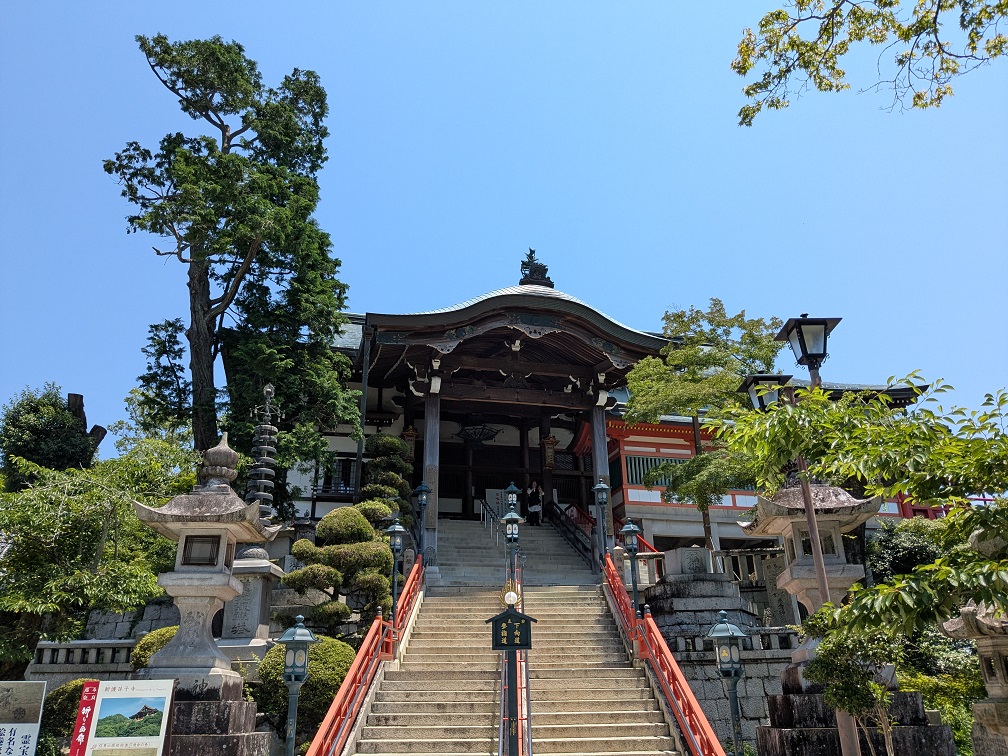
The Chougosonji temple. It's very deeply connected to mythology referenced to in Undefined Fantastical Object.
Before the forced division of Buddhism and Shinto, temples and shrines often co-existed, with shrines revering the deities as kami and temples revering them as manifestations of buddhas and bodhisattvas. Buddhism in Japan did not replace the local faiths, but rather built on top of them. Sites that were revered under a different narrative became integrated to the Buddhist view of the world. An example of this is how there was a medieval Japanese narrative about the male deity at Suwa being the manifestation of an enlightened Indian Buddhist king.
There was however another Suwa-related Buddhist narrative, which is related to a process where different locations in the world were seen as being manifestations of Buddhist cosmology or concepts. In the case of Suwa, it was seen that Takeminataka no Mikoto was the manifestation of Fugen, and Yasakatome was the manifestation of Kannon. This was based on superimposing the Womb Realm mandala on Lake Suwa. The Womb Mandala is centered around Dainichi Nyorai, the Cosmic Sun Buddha, and has eight other Buddhist deities in the eight directions surrounding him. On the southeast corner is Fugen, and on the northwest corner is Kannon. These two directions correlate with the direction of upper and lower Suwa shrines.
Suwa is nowhere near the only example of this. Other examples include the Koyasan temple complex being regarded as a kind of pure land on earth and as a mandala, and at times all of Japan being seen as a kind of vajra with the center being at Lake Biwa, a site prominently associated with Benzaiten. Perhaps the most common type of Buddhist cosmology that was seen reflected in the everyday world was various locations from the Ten Realms, and at times all of the Ten Realms. Examples of this include seeing volcanic valleys or dry riverbeds as being manifestations of hellish realms on Earth.
The locations that were thought to be manifestations of all the Ten Realms at once were mountains. This is a direct analogy from the superstructure of Buddhist cosmology. The ten realms are centered around the cosmic mountain of Mt. Sumeru. At its lowest slopes are the hellish realms, and at its peak are the realms of fully enlightened beings. All of non-enlightened existence goes in cycles of going up and down along this mountain. There are also guardian deities associated with this cosmology in Japanese Buddhism. These are the fierce and fiery Myoo, or Luminous Kings or Wisdom Kings. At the center sits the unmovable Fudo Myoo, and four others guard the cardinal directions. Bishamonten, sometimes worshipped as his own deity, is one of these guardians, and he guards the north. Interestingly enough, each of the four guardians of cardinal directions are thought to command some type of non-humans, some of which are considered very troublesome entities in Buddhism. The Buddhist cosmology thus appears to follow rather closely Eliade’s world tree topology, with its “outside world” being populated by non-humans.
The Buddhist cosmology serves a role of both an earnest object of belief, as well as a tool of ordering the universe in accordance with Buddhist teachings so that all of reality becomes a kind of transmission of Buddhism. The whole cosmology of Mahayana Buddhism extends beyond the Ten Realms and Mt. Sumeru, and includes things like the various Pure Lands, as well as realms of non-humans which don’t neatly fit into the Ten Realms. Japanese Buddhism had to grapple with local particularities, and there are cases of things like the tengu and certain demons being seen as parallel reincarnation tracks for Buddhists who however were too prideful to achieve awakening and outside of strict Ten Realms scheme. As Buddhism holds that reality in its totality is unified and beyond human categories and comprehension - the coincidentia oppositorum - the Ten Realms may exist but ultimately seeing them as ten separate realms and not as a single whole is simply a way to conceptualize things.
While Taoism did not become a mass religion in Japan, it did have an influence on broader Japanese ideas on sacred geography and mythological cosmology. In some cases it had a very concrete influence on which sites became considered particularly sacred.
Taoism has a fairly straightforward axis mundi in its tradition in the form of Mt. Kunlun. This mythological mountain is sometimes even depicted as being a pillar. Since it bears a lot of similarities to Mt. Sumeru is considered to be in the “far west”, some have thought that the Mt. Sumeru cosmology of Buddhism influenced these aspects of Mt. Kunlun mythology. Whether these similarities are of indigenous Chinese origin or later influence, Mt. Kunlun serves as the center point of the world in Taoist cosmology. It’s considered a hollow mountain directly under the Pole Star, thus linking it with the Heavens. Its peak reaches high into the sky, and its roots go deep into the Earth. Sometimes this mountain is depicted as being composed of several layers. From Mt. Kunlun flows four rivers that divide the world into four quadrants.
Mt. Kunlun is often depicted with fantastic, mysterious and extravagant qualities. It’s considered related to the Supreme Deity, with his palace either being on top of Mt. Kunlun, or then the mountain serving as a kind of ladder to the palace in the skies. It’s on this mountain that the two last surviving ancestors of humans, Nuwa and Fuxi married each other and restarted civilization. Xiwang Mu, the ambiguous goddess of life and death who transcended her demonic nature, is also said to dwell on Mt. Kunlun. Besides deities and magical fauna, Mt. Kunlun is populated by immortals and shamans. In fact, it’s often believed that if one reaches the top of Mt. Kunlun, they become immortal themselves. Accordingly, Mt. Kunlun is said to be extremely difficult to access, and only those versed in the spiritual arts may do so.
At times Mt. Kunlun is contrasted with another holy mountain of immortals, Mt. Penglai. This mountain is said to be located on an island that is far east from the coasts of China. It’s described as a paradise-like place, with palaces of gold and silver and food and drink which never runs out. There is no suffering and there is no winter. It’s populated by immortals, and there are magical trees that have fruits that can heal, turn one immortal and even raise the dead. Some identified Penglai as being Japan, and the Penglai mythology became disseminated there. In Japanese, Penglai is called Hourai. There it became part of Japanese mythology, including a reference to it in the Tale of the Bamboo Cutter. There are also place names in Japan which include references to Hourai, for example the Houraioka, “Hourai Hill”, at Mt. Hiei. That particular place contains a cave that serves as a memorial site for those who died when Oda Nobunaga destroyed the Enryakuji temple complex. While Hourai retains its paradisical connotations in Japan, later depictions also depicted it as a bitterly cold place inhabited by fairy-like creatures.
While not exclusively Taoist, the Chinese have a very strong culture of mountain reverence. The so-called Five Great Mountains of China are associated with the center and the cardinal directions surrounding it, and the wu xing, planets, seasons and deities associated with these directions. In the traditional worldview, this makes China itself a kind of cosmogram, what would in Buddhism be called a mandala. There are also more specifically Taoist holy mountains in China. A common type of a sacred site in China are the so-called grotto-heavens. They are caves, grottoes, mountain hollows and other underground spaces, often in the mountains. It was said that there were lands between heavens and earth that were full of places like these, populated by immortals.
Taoism also has a more cosmic aspect to its cosmology that is related to the great interest in astrology by early Taoists. As seen from the Mt.Kunlun mythology, the Pole Star was considered to correlate with the center of the world. The movements of the Big Dipper divided the seasons with its movements. Changes in the heavens, the movements of celestial objects, the cycles of planets and stars were thought to influence events on the world. Important Taoist ritual and conceptual tools like the Hetu and Luo Shu magic squares were based on astrology. Hetu means literally “Yellow River”, but the river in the diagram is not the one on Earth, but rather the Milky Way. Beyond their uses in rituals, divination and magic, these squares were also used for planning cities, tombs and temples.
These magic squares are also associated with the bagua trigrams, and the bagua can in this light be understood as a framework for understanding celestial influences on Earth.The eight bagua are each associated with the eight directions, and in fact, the hexagonal arrangement of trigrams is often called the compass of bagua. Thus the various qualities which bagua refer to are thought to manifest in a microcosmic manner in the world. By harmonizing things like city planning, construction of homes and arrangement of items one can then tap into the celestial powers and avoid misfortune.
The wu xing were thought to be represented or emanated from the classical planets, yet they were also conceptualized as a phenomenon on Earth. While “Wood” and “Fire” were not just literal wood and fire, they were also literal wood and fire. Thus certain places had certain qualities more or less in tune with certain types of wu xing, and these particularities of a place’s qi, energy, were thought to have an impact on people. Feng shui developed theories regarding the flow and potential obstructions of chi and how different geographic features and human constructions affected these flows. On an even higher level, all things were seen as having either yin or yang qualities. Thus the fractal nature of Taoist cosmology extends all the way into every aspect of the physical world.
This type of Taoist geomancy works in at least two ways. On one level it was an attempt at understanding the impact of the environment on people. The ancient Chinese made empirical observations on things like the changes of the seasons and the health of people in various environments. They found correlations between certain repeating events and tendencies and the cycles of celestial bodies. They also found for example that people living near swamps appeared to be sicker than average. The damp qi of the swamps was blamed for this. One can see this as a kind of shorthand for various factors like excessive moisture, presence of disease-spreading bacteria and insects in the water and so on that would impact people living in such places.
On another level, the Taoist geomancy works as a kind of ordering principle. This can be viewed, depending on your interpretation, as either genuinely capturing some higher principle, or as a Marvin Singhian process of soothing the uneasy through “magic”. With all of the universe reflecting certain principles in a fractal manner, things like the compass of bagua can be deployed everywhere to bring order, clarity and control everywhere. Whether one believes in the more numinous aspects of Taoism is irrelevant, as for the true believer there would at least be a psychological effect. These sort of grand theories of the world do bring a high degree of ontological certainty, and people don’t tend to deal with uncertainty too well.
In Japanese context, onmyodo made use of Taoist geomancy. Because the onmyoji were tasked with the spiritual protection of the capital, there was one direction that was of particular interest to them. This was the northeast, known as the Demon Gate. It was thought that malevolent spirits come from this direction. Interestingly enough, this belief informed the decision behind founding a major Buddhist temple complex near Kyoto. The location of Enryakuji, the foundational site of Tendai Buddhism, was chosen to be northeast of Kyoto so it would help protect the capital from hostile spirits. This is a Japanese example of Taoist principles being put into use in city planning, the magic squares of China imprinting themselves on Japanese soil.
After onmyodo lost its imperial patronage, it left the confines of the court in Kyoto. While it never had the kind of power or prestige it once had, it left its mark on Japanese folk spirituality. Many ideas of Taoist origin, including Chinese astrology and the idea of auspicious and inauspicious times, dates and directions can be traced back to the influence of onmyodo on Japan.
Onmyodo has also laid its roots into a bit of sacred geography of its own. After the passing of the most famous of the onmyoji, Abe no Seimei (921-1005), a shrine was built on the grounds of Seimei’s home in Kyoto. The shrine remains there to this day. While not large, it has a quite distinct style, with pentacle-iconography related to the wu xing as well as art illustrating legends associated with Seimei. One can even find a sculpture depicting one of Seimei’s spirit servants on the shrine grounds. The shrine’s goods have a striking visual style, and this combined with the fascinating history has made it a rather popular pilgrimage destination among the Japanese. Seimei shrine is a good example of spiritual history and mythology crystallizing into material locations one can visit and take part in, even hundreds of years after the time of the legends.
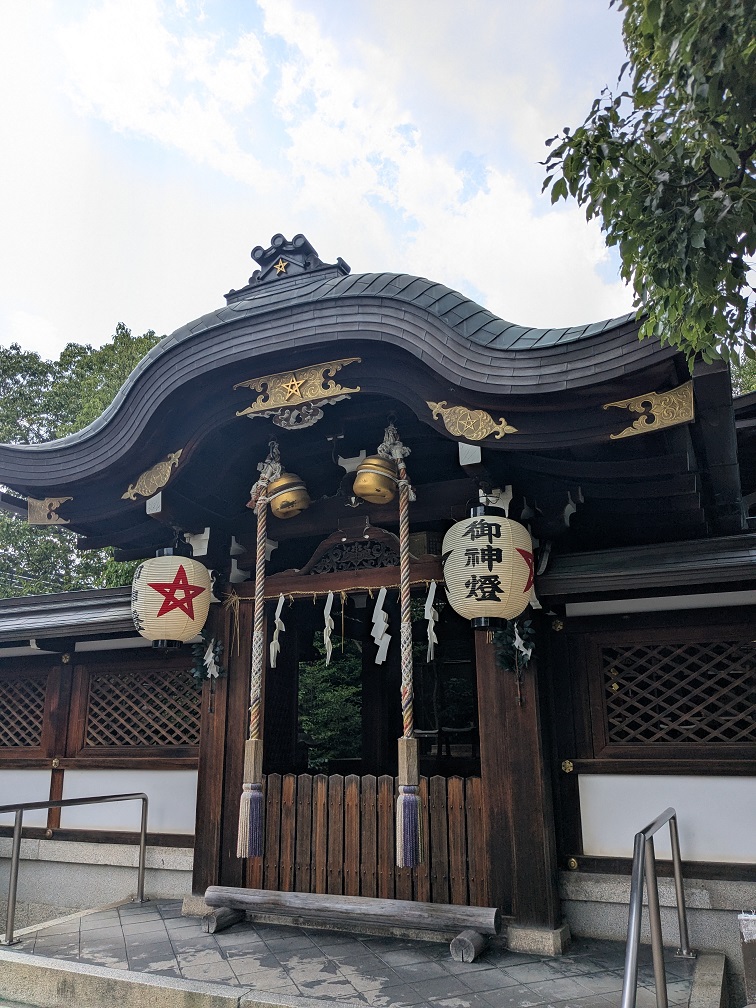
The Seimei Shrine has some very distinct iconography.
Sacred sites naturally invite visitors, and historically pilgrimages were a notable part of Japanese culture. During the shogunate era, pilgrimages were one of the few reasons why people were allowed to travel. They were a mix of earnest spiritual journeys, and thirst for adventure and novelty. People would organize into clubs which gathered fees from members which would allow few of them at a time to do the pilgrimage. Sometimes teenaged children would simply run away from their homes en masse into pilgrimages. Popular destinations included the shrine complex at Ise, and the 88 temples of Shikoku.
Inland travel remains an important part of Japanese culture to this day, and many travelers go to the same temples and shrines as their ancestors would have gone to. The word “pilgrimage” has however acquired a new layer of meaning. It has also come to refer to journeys to places which are featured in TV shows, anime or games. A kind of class of “otaku pilgrimages” has emerged. Some of these locations are of more mundane nature, such as street crossings or particular schools or hills featured in a work of fiction. Sometimes however these otaku pilgrimages and historical sacred sites intertwine, as places like shrines or temples are featured in fiction. Touhou is one of those works of fiction which have featured references to real life sacred sites, and we will take a closer look at these later. For now, this intermingling of otaku pilgrimages and historical sacred sites does raise some interesting questions about the nature of the sacred and its relationship to culture. To what extent historically pilgrimages too were kind of “otaku pilgrimages” of their day, and is it possible for an “otaku pilgrimage” to become just a pilgrimage?
Even in older times, the more secular and commercial aspects of culture - as much as these were even separate from “religion” - surrounded sacred sites and pilgrimages in older times in Japan. Merchants and entertainers flocked to places frequented by pilgrims, and for some the pilgrimages could be rather indulgent affairs. Some communities produced people presenting themselves as holy figures to meet the pilgrim’s demands for meeting such figures on their journeys. Pilgrims could include in behaviours which today would be frowned upon, like attaching talismans with their names and wishes on them on temples and shrines. In short, historical pilgrimages seemed to have shared quite a lot with modern tourism!
In Japan, sacred sites have also been subjects of literature, poetry and arts, precursors to popular culture, since premodern times. During the Heian period, a culture of utamakura, “poem pillow”, emerged. This is a concept referring to the use of intertextual references to sacred sites and places of historical importance. Poems about places where people went to pilgrimages were popular, especially among women of the Heian court who were not allowed to go on such things themselves. The massive Konjaku Monogatari Shu collection of stories features many stories taking place at the sacred Mt. Hiei. Saigyou Hoshi (1118-1190) fled the emerging conflicts of the Kyoto court to the mountains and became a poet-monk. Matsuo Basho (1664-1694) was inspired by Saigyou and wrote many poems inspired by his journeys. During the Edo era, literacy in Japan increased greatly, and this cleared the way for the birth of popular literature. Kyoukutei Bakin (1768-1848) was one of the most productive writers of his era, and many of his works feature samurai adventuring in the mountains, meeting creatures from Japanese folklore and mythology. Visual culture developed also strongly during the Edo era. In particular, ukio-e, “pictures of the floating world”, woodprint pictures featuring scenes from history and mythology, popular actors, flowers, animals and erotic content became extremely popular. Some ukio-e also featured landscapes, and Katsushika Hokusai (1760-1849) created the Thirty-six views of Mt. Fuji, featuring the sacred mountain. This series became extremely popular and iconic.
Sacred sites in Japan have been objects of reverence, the pillars of local communities, places of divine history on Earth, world-explaining cosmograms, teaching devices, manifestations of other realms on Earth, and sites of nostalgia. They have been the subjects of earnest devotion, romantic longing, thirst for adventure and wild speculation. They have been referenced in popular culture and studied by scholars. Their names have changed, the way their sacredness has been conceptualized has changed, and the reasons for visiting them too have changed, yet still year after year, people visit them. They have been burned by wars or lightning, toppled by earthquakes, vandalized by pilgrims and tourists and rebuilt again and again and again. Their sacred quality has survived shifts in culture over the decades and centuries. Much like those neolithic sites which later have hosted Marian apparitions, there is something in those places which compels people to go there generation after generation. Whether this is simply natural beauty, the weight of history and culture, the opportunity to enter a state that is divergent from everyday life or something more numinous is up to everyone for themselves to experience and decide.
No matter when you think of the topic, it is clear that these locations inspire people year after year. Touhou is one of those things inspired by many sacred sites in Japan, and in a sense Gensokyo has its own sacred geography and mythological cosmology. Before we move on to that, we will take a closer look at a certain tradition that sits at the intersection of the topics of this section - syncretism, shamanism, sacred geography. That tradition is shugendo.
Shugendo Retour
We’ve already taken a brief look at Shugendo at the Buddhism section, but a closer look is in order. This is because it is intimately tied to the topics of this section. Shugendo stands at the intersection of syncretism, shamanism and sacred geography. Shugendo is an ascetic movement that is based around practices done in various sacred mountains. Some have called it a “mountain religion”, while others don’t see it as a distinct religion, but rather a set of beliefs and practices adjacent to Japanese Buddhism. Shugendo is commonly associated, depending on the sect, with either Tendai or Shingon Buddhism. What sets it apart from these forms of Buddhism are ascetic practices centered around mountains and reverence of syncretic deities known as gongen.
A gongen is thought to be a “provisional” manifestation of a buddha in this world. This is related to Japanese Buddhist ideas of honji suikaku, original enlightenment, and the idea that various Japanese kami are local manifestations of various Buddhist deities. While the term has been used for other types of deities, in Shugendo these very much tend to be associated with particular sacred mountains. An example of such would be the Iizuna Gongen of Mt. Iizuna. So whether shugendo is a “mountain religion” or not, it’s so tied with mountains that its practitioners are called yamabushi, “those who prostrate at mountains”. As the holy mountains of Shugendo were sacred most likely even in pre-Buddhist times, it can be seen as syncretization of Buddhist and indigenous beliefs.
Shugendo was also influenced by Taoism, as certain Shugendo practices have identifiable Taoist origins. These include certain spells used by the shugendo, most notably the kuji-kiri. Shugendo dietary taboos during practice go beyond the Buddhist norm, and the abstinence from grains and belief in internal “worms” which consume grains are of Taoist origin. While Japan had indigenous mountain worship that predated both Buddhism and Taoism, the Taoist ideas about immortals dwelling in the mountains might have also influenced more broadly shugendo ideas about mountain practice having particular spiritual importance.
At the heart of Shugendo are ascetic practices which were especially historically at times extremely harsh. These include pilgrimages up to the sacred mountains, not an easy feat in itself, especially done with the traditional shugendo garb that eschews modern comforts. The practitioners commit to a sparse vegan diet on these journeys, and they may observe some taboos such as not washing themselves. There are trials and rituals involved. These can be things like being locked into a dark space, being held with a rope over a cliff or being exposed to the smoke of burning peppers. There are also certain tests for the spiritual potency of a shugenja. These include things like walking a ladder of blades, walking on hot coals or entering boiling water. The yamabushi became expert mountaineers. In 1907, Yoshitaro Shibasaki led a team up Mt. Tsurugi, which was considered the last unclimbed peak in Japan. To their astonishment the team found artefacts related to Shugendo at the top of the mountain, dating back to roughly the 900s.
Traditionally, it was thought that these pilgrimages and the trials and rituals faced there mirrored a journey through the ten realms of Buddhism. Thus by undergoing the journey, the practitioner experienced a kind of rebirth in this life that was thought to allow one to be closer to buddhahood, perhaps even this life. This is the influence of esoteric Buddhism on Shugendo, the very same sokushin jobutsu, buddhahood in this very body, that practitioners of esoteric Buddhism seek. The arduous ascetic practices were thought to endow people with spiritual powers. These would include a wide range of things, such as being able to talk to animals, the ability to exorcise spirits and the ability to “open” sacred places. The last one refers to an idea of there being a kind of latent holiness or enlightened quality in certain places which could be made manifest by a yamabushi.
An important part of shugendo training is essentially the acceptance of one’s death. After all, there can be no rebirth without death. The traditional shugenja garb is white, the color in which the dead are dressed in Japan. Whatever hardships and trials the shugenja may face in the mountains, they are supposed to accept it without complaints, be it hunger, cold or heat. An example of this attitude is that during the Dewa Sanzan pilgrimages, the only word that the participants are allowed to speak is uketamo, or “I accept”. No matter what happens, one is supposed to accept it, up to their own death. In old times, sometimes shugenjas really did die on the mountains. They were buried there with their walking sticks which to this day resemble the wooden sticks used to mark grave sites in Japan. Historically some yamabushi took this acceptance of death and the pursuit of buddhahood in this very body to the extreme, and became mummified alive. The other side of the coin to the acceptance of death is the acceptance of rebirth. Thus traditional Shugendo attire also contains symbolism related to rebirth, taken from esoteric Buddhism. Historically, this perceived potency for rebirth drew in not only spiritual seekers but also criminals and outcasts looking for redemption.
The origins of Shugendo can be traced back to the semi-legendary En no Gyoja (634-~707), “En the Ascetic”. Details of his early life are sparse, but he is believed to have been some sort of a minor noble, as otherwise certain interactions with nobility he is said to have would have been impossible in the strict society of feudal Japan. Towards the end of his life, there are records of him being exiled from the court for use of “weird magic”. He however chose a life of ascetic practice in the mountains over the court. The foundational legend of Shugendo goes like this: seeking to turn the recalcitrant and hardened Japanese into Buddhists, he goes to Mt. Katsuragi to seek help for his cause. Practicing asceticism there, he is eventually visited by bodhisattvas and buddhas. The exact figures vary a bit from legend to legend, but one version has Kannon appear first, then Miroku. En no Gyoja finds these figures too soft, and finally a terrifying wrathful deity known as Zhao Gongen appears. En no Gyoja accepted this fierce deity, and thus Zhao Gongen became the patron deity of Shugendo and a fierce dharma protector.
Besides their own practice, shugenja can also provide services for others. These include things like divination, using spells, creating charms, herbal medicine, exorcisms and mediumship. It’s the mediumships and exorcisms that give Shugendo that has been described as shamanic. Historically the yamabushi were seen as potent exorcists, and the wilder the yamabushi appeared, the stronger exorcist he was considered to be. The proximity to the wild spirits of the mountains was thought to give them particular connection and authority over spirits. Shugendo mediumship can include things such as asking spirits of the mountains for forecasts regarding weather on the mountains. Another service that the shugenja would provide was acting as mountain guides for pilgrims. So the shugenja acted as kind of spirit guides of sorts too, leading aspirants towards spiritual fulfilment through treacherous territory.
Shugendo can be seen in many ways, and one of them is a kind of withdrawal from civilization. The shugenja were seen with a mix of awe, suspicion and fear. In certain places they were highly respected for their skills and people sought both spiritual and medical aid from them. Commoners sometimes found the hardened, weather-worn yamabushi more respectable and relatable than the rather sheltered monks of Buddhist temples. On the other hand, in some places they were viewed with suspicion. The fact that some yamabushi were former criminals raised suspicions. While the wildness of yamabushi was also a spiritual merit to some, others found it simply scary and alienating. Conservative elements of the Buddhist elements viewed the yamabushi suspiciously, as En no Gyoja’s exile demonstrates. The shugenja’s exceptional mountaineering skills made them equated with the tengu, and at times the tengu were seen as being very hostile to humans. There were even theories that the tengu were reincarnated buddhists who had become too prideful. Perhaps this was a genuine perception, perhaps it was slander from the more purist elements of the Buddhist establishment.
Because of the inherently syncretic nature of Shugendo, it was of course banned during the Meiji reforms in 1872. While the ban was lifted after the Second World War in 1945, the band had greatly damaged the various Shugendo lineages. Carmen Blacker, who studied the shugenja during the 1950s and 1960s noted that while the overall ritual structure of mountain pilgrimage as a travel through the Ten Realms persisted, some of the rituals had become lost over time. While Blacker speculated that the movement might disappear entirely, Shugendo has survived to this day. It has become more accessible, and certain Shugendo groups offer shorter retreats and training periods for people tangled with busy urban lives. Rather than a radical process of rebirth, the modern part-time shugenja might seek to reconnect with the natural world and the cultural heritage of Japan. More long-term Shugendo practice still remains extremely demanding though, and is the realm of serious aspirants which these days include few foreigners too.
Shugendo has become a respected part of Japanese cultural heritage. Some even regard its complex mix of influences and entanglement with the natural world as “representing the very soul of Japan”. The feats of shugenja were subjects of folk tales and popular culture even in premodern times, and the “occult boom” of the 1980s brought renewed interest to the feats of the yamabushi. One can find references to Shugendo in anime, manga and video games. These include Touhou.
While Touhou doesn’t have many direct references to Shugendo, there are some to be found. Some of Touhou’s references to things from esoteric Buddhism and Taoism might have come via Shugendo. The most straightforward reference is the character of Megumu Iizunamaru. She is inspired by Iizuna Gongen, who is depicted as a tengu-like deity. Her association with the kuda-gitsune Kudamaki Tsukasa is a reference to Iizuna Gongen being depicted as riding a fox. Touhou’s depiction of the Tengu mirrors the historical trend of depicting the Tengu wearing Shugendo attire. Rather than the full garb, the tengu of Touhou wear the characteristic tokin skullcaps. Lotus Eaters also contains a reference to spiritually inclined humans of Gensokyo seeking shelter in the mountains, often with the end result of becoming abducted by the highly territorial tengu. Perhaps these would-be hermits are a reference to yamabushi. Ibaraki Kasen’s character has some yamabushi-like features. The mountain austerities she forces Reimu to perform contain things done by the yamabushi, and the idea of an outcast, in this case a notorious oni, seeking salvation and reformation - and perhaps escape - through becoming a mountain hermit is very much in line with some of the historical yamabushi.
Another reference to Shugendo that ZUN has made is from the time between the pc98 and Windows era games, during which he focused on making art. He drew a picture of a shrine maiden on a mountain slope titled “Training on Mt. Haku”. Mt. Haku is a Shungedo sacred site. The shrine maiden is holding a staff with metal rings on the top of it, and these types of staff are strongly associated with the shugenja. There are also fan theories connecting Mt. Haku to Hakurei Shrine, after all the miko in the picture looks a lot like Reimu does. In the very first Touhou game, Highly Responsive to Prayers, the stage graphics for Hakurei Shrine include kanji referencing Mt. Haku. In ZUN’s old hometown of Hakuba there is a now-ruined shrine known as Joumine shrine which allegedly houses among others the kami of Mt. Haku. These among other things have led to theories that Joumine shrine was the inspiration behind Hakurei Shrine in Touhou. While Reimu is not depicted as being particularly yamabushi-like person, showing great distaste for the mountain trials that Kasen put her through, her role as an exorcist and spirit worker is closer to shugenja of old than modern shrine maidens.
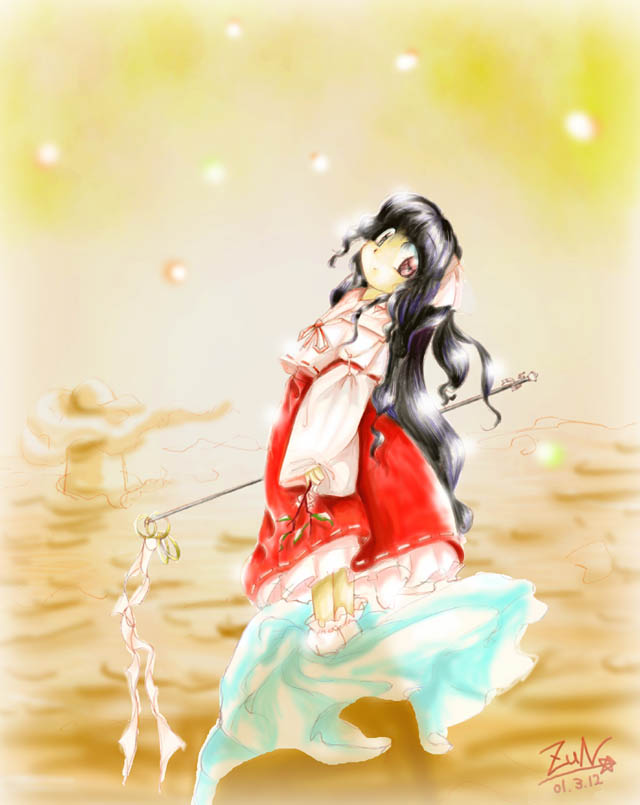
"Training at Mt Haku" by ZUN. Real-life shugendo was closed off to women for centuries, and women in general were banned from entering most of the sacred mountains.
Touhou in the Spiritual Landscape of Japan
The spiritual traditions of Japan evolved in a specific place and time, and they interacted with each other in a specific context. Japan’s awe-inspiring mountains have left a strong impression on Japanese culture, shaping the communities in very tangible ways. The reason why Japan is so densely urbanized yet has so many natural sites barely touched by humans is that the volcanically active, mountainous terrain makes much of the country borderline impossible to build or farm on. Typhoons, floods, storms and tsunamis pose a threat even in modern times, and during the era of wooden construction, fires were a severe threat in the cities. Japan’s summers are hot and winters are snowy. Japan is a place where the land itself demands respect, even as humans have mastered many aspects of it. So even if one would not believe in the numinous, it’s easy to understand the kind of reverence the Japanese would feel for their land.
There is a legitimate case to be made that Japan’s mountains have served as a kind of world pillar to its communities. In old times, the local mountain was seen as a site of deities and ancestral spirits who would come and go with the seasons, bringing life in the spring and returning with the harvest. These mountains would have served as very real points of reference for the locals. As Japan became politically more and more unified, certain mountains would ascend to national status. Faiths which went beyond the local borders developed, drawing pilgrims from far away to certain sacred mountains. These days, Mt. Fuji stands as a kind of axis mundi for the Japanese, or at least as a kind of shorthand for all of Japan itself. Buddhism would find Japan’s geography fitting to its cosmic vision. Whatever the names or legends associated with certain places, they were seen as being sacred, part of or associated with numinous realms. To journey to such places was to go from this world to, if not another world, then a state between the worlds.
Most of all, the land, especially the mountains, was considered to be alive with all sorts of numinous entities, and some of them could become troublesome. Paying the proper respect and staying away from places where one should not stray was always the first course of action, but this was not always enough. Mischievous kitsune and tanuki, unruly oni, territorial tengu, strange youkai and resentful spirits of the dead were all seen as having the power to cause problems for humans. Whether one thinks of these as being something with agency and power of their own, or simply reflections of human emotions, people sought means to control these forces. Buddhism became popularized in part because it offered tools for dealing with these phenomena. Onmyodo offered its own take on controlling troublesome spirits and dangerous influences, and this no doubt contributed to its favor within court and the later dissemination of practices derived from it. These ideas mingled with older, indigenous traditions and ideas about the spirit world and gave rise to Shugendo, perhaps the ultimate expression of how Japanese spiritual traditions would blend together.
At times the Japanese traditions have lived together rather harmoniously, and at times they have been violently at odds with each other. Politics, be they of the Heian era court, of the Shogunate, the restored Meiji empire or the religious freedom after Second World War, have always been tangled with how religion has manifested in Japan. Noble patronage and popular movements alike have shaped both Buddhism and Shinto, and the Taoist influences have been felt both within court walls as well as the stalls of street fortune tellers. Religion has been the cornerstone of the community, an earnest object of practice, justification for wars and rebellions, a treasured cultural heritage and to some an embarrassing reminder of the past in modern times. These complexities are hardly unique to Japan, but the complicated religious history of Japan does highlight them, as despite some rather spirited attempts, no single religion ever truly managed to subdue all the other ones.
To put it shortly, Japan has a very rich history when it comes to its spiritual traditions, and they have been shaped and continue to be shaped by the geography of the country and the broader politics of its inhabitants. It’s in this context that Touhou has situated itself. And as Touhou deals with the supernatural, matters of belief and faith and the various numinous entities the Japanese believed - and believe - to fill their lands, it is specifically a spiritual history it places itself in. Touhou’s messy view of the “other world” of Gensokyo, where conflicting narratives shape reality, is a mirror of how complex Japan’s traditional views of the “other world” are. It’s a country where no single view of the afterlife and spirit world was ever truly settled on, and where one type of entity was revered in one village and feared in another.
Touhou is at the same time a celebration of the complexities of Japan’s spiritual history, and at the same the ultimate grand unified theory binding these traditions together. Everything is true because reality is shaped by the power of belief. All the youkai, kami and phantoms exist because a kernel of belief remains, enough to give a shape, name and legacy to go on. Yet this legacy is not the same as it was 1000 years ago. At least certain entities of Gensokyo are very well aware of their nature as entities born out of narratives, and seek to steer these narratives to their advantage and enjoyment.
Even the way Touhou is critical of organized religion mirrors not only modern sensibilities, but also some older ones. It wasn’t exactly unheard of for there to be folktales, otherwise posited in culture earnestly believing in the numinous, that ridiculed monks from city temples who were seen to be alienated from the people and soft from sheltered life. There was a kind of tension between humanity and the divine, with deities being both revered and also feared, for they were seen as having an angry side too, which manifested in disasters and pandemics. Religion in Touhou is a kind of self-conscious fakery. Yet because the deities, supernatural and magic objectively exist, it is also a self-conscious non-fakery, essentially narrative engineering for the purpose of causing a change in reality, at least the local reality of Gensokyo. This however is not only the power of gods, and fits of fears and manias in common folk cause changes in Gensokyo through the weight of belief alone. These sort of ideas are Touhou’s most radical break from tradition, yet one can find similar ideas in Buddhism, ideas related to youkai - and fascinatingly enough, certain Western esoteric schools.
Rather than Touhou being a direct continuation of any particular lineage of Japanese spiritual traditions, it’s perhaps best seen as continuation of culture about Japanese spiritual traditions. Touhou can be seen on some level as a modern take on ghost stories, fairy tales and strange legends of the old. What sets it apart from the traditional stories - apart from its medium and certain narrative choices - is its interest in the ontology of belief and the implications for spirituality that flow out from it. This isn’t entirely unprecedented, as some later scholarship and entertainment about youkai comes close to this kind of “ontology of belief” that Touhou engages in. Touhou doesn’t engage in attempts at scaring those engaged with it - though it can get surprisingly dark and spooky - nor does it serve hagiographies of monks or samurai or offer much in the way of moral lessons. What Touhou does engage in is a kind of opening of the space of possibility through playing with the power of belief and the ambiguous relationship between Touhou’s fictional outside world and our present world. This can be seen as continuation of certain Japanese storytelling practices, such as the hyaku monogatari, where it was said that the telling of hundred ghost stories would cause a ghost to appear. Another point of reference is the Chinese tradition of strange tales intended to blur lines between “real” and “supernatural”, which in turn likely influenced Japanese storytelling traditions. Gods and monsters populate these stories as agents who crack open a gap to the numinous world, in Eliade’s terms, allowing the sacred to enter into everyday reality.
The non-commercial nature of Touhou also brings it closer to folk tales than more explicitly commercial cultural ventures. As a doujin work, everyone who agrees to a set of guidelines is welcome to take part in the process of co-creation. In some sense this is reminiscent of the process where a central mythology starts to radiate local - in this case personal - interpretations of the mythology. The Japanese creation myths are in some form shared across the islands, yet even as there remains a broad consensus, there are local variations of these legends. Much in the same manner, different segments of the fandom each have different interpretations and focuses.
Touhou isn’t entirely free of commercialism. You buy the games in exchange for money, and doujin works too are exchanged for money. There’s a lively material culture of all kinds of associated collectibles, and there’s even been collaborations with various commercial establishments, up to McDonald’s in Japan. Religion, spirituality and folklore have never been entirely free of what these days would be called commercialism either. One can buy Touhou keychains at Akiba Hobby, and one can buy omamori at shrines and temples. Commercial phenomena surrounded pilgrims, and one can find all kinds of goods stalls around popular shrines and temples, especially during holidays. Touhou of course comments on this commercialism of religion, while being surrounded by commercial phenomena. These include conventions, which do have a strong co-creative element, it needs to be said. The interestingly named Reitaisai (“annual festival”, as in shrine festival) is a premier example of this convention culture in the context of Touhou. While its naming is intended to evoke the traditional matsuri in some sense, at least offering an opportunity for the community to come together, these kinds of conventions tie to an interesting bit of lore related to Japanese folklore. The Japanese convention culture can be traced all the way back to Tokugawa era “product conventions”. These initially served ostensibly for people involved in a project to chart the medicinal plants of Japan to share their findings. They soon evolved into a more general affair, which included people telling strange tales and displaying odd findings from their journeys. These conventions did much to disseminate what would shape into Japanese folklore, especially one related to youkai.
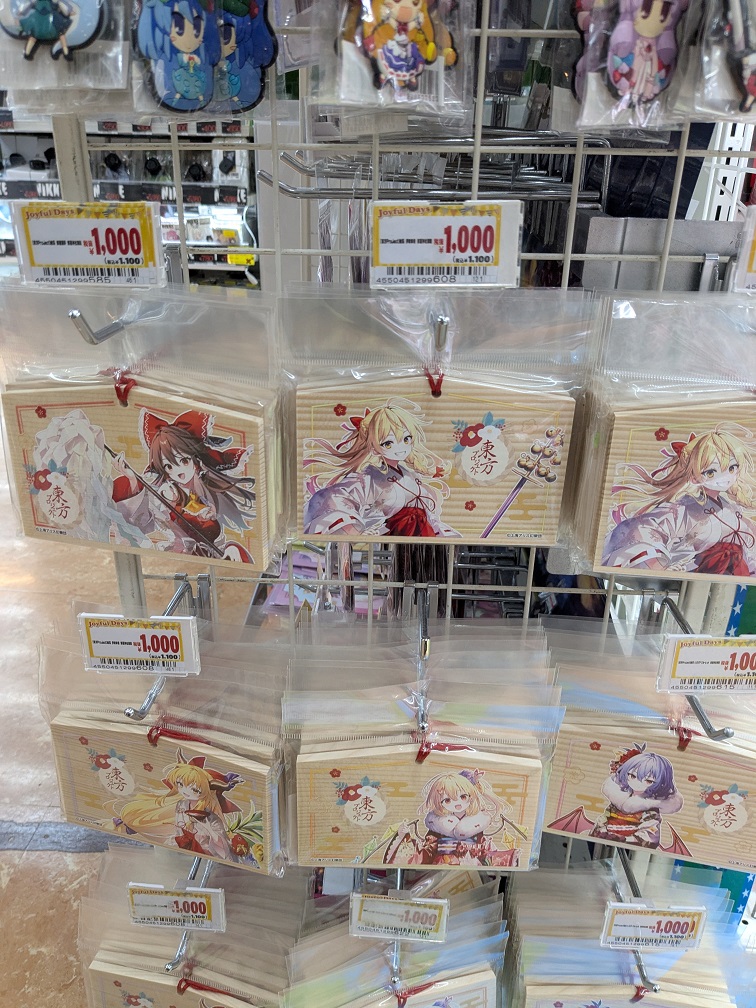
Touhou fan goods shaped like ema prayer plates for sale at the Akihabara Don Quijote.
Extremely fascinating meeting point of fandom, religion and commercialism.
I have no idea if these would be accepted at a Shinto shrine.
The modern state of religiosity and spirituality in Japan is a difficult topic. Some people like to conceptualize modern Japan as an essentially irreligious country, owing to statistics which point to a comparatively low number of people identifying as participants of a named religion. This isn’t the whole picture, as many Japanese do take part in religious festivals, memorial services and shrine visits. Whether this is done out of tradition, custom, or an earnest belief and experiential dimension is a question that mass surveys cannot penetrate. A very large number, the vast majority of Japanese, interface with local religions and traditions in some capacity. This is in contrast with the West, where declared faith far exceeds actual participation in worship.
The concept of “religion” is alien to Japan, introduced during the Meiji era, and has come especially after the Aum Shinrikyo terror incidents of 1995 take cultish meanings. Japan has a difficult history with historical corrupt practices by Buddhism, the militarism of State Shinto and exploitative practices by New Religious Movements. The current spiritual landscape of Japan cannot really be conceptualized in terms of “religious” and “non-religious”, because “religion” as modern West understands it is not a Japanese concept. Some have said that the Japanese are “superstitious, not religious” or that the Western New Age adage of “spiritual, not religious” describes the attitudes of many. Being very deeply into religion or spirituality doesn’t seem to be part of the mainstream modern Japanese culture, and those deeply interested in these topics are subcultures of their own.
What however seems quite apparent to me is that the Japanese keep on interfacing with their traditions, in one form of another, either as tradition, earnestly lived practice, or as fuel for fiction and entertainment. These categories are not impenetrable silos, and the interesting question is what happens when what was tradition or fiction becomes something else and comes alive. As far as I can tell, there are a number of Japanese people who are very deeply interested in the historical and folkloric background of Touhou. What this interest exactly is and what fuels it is difficult for me as a non-native, non-fluent Japanese speaker to answer. When it comes to belief in the spirits of Gensokyo, a group of people known as the Dream Exploration Group, who believed in the existence of Gensokyo and sought to find it. Some of its members apparently drifted towards more traditional forms of Japanese spirituality. I imagine these kinds of people form a niche within a niche, the otaku among otaku.
Having now situated Touhou in this “spiritual landscape” of Japan, it’s time to take a look at how Gensokyo has a kind of sacred geography of its own, and how it interacts with locations that can be found in our world.
The Sacred Geography of Gensokyo
Gensokyo has a kind of sacred geography of its own. This works on several different levels. On one level, many of its locations are references to pre-existing mythology. Sometimes these sites can be concretely found in the world, and sometimes they are of more mythological or otherworldly nature. On another level, Gensokyo can be seen as reflecting more archetypal qualities of sacred geography, such as the axis mundi and liminality. Through references to real world locations, Touhou has also started to superimpose its sacred geography on the “Outside World”, and locations associated with Touhou have become destinations for otaku pilgrimages.
The arguably defining quality of Gensokyo is its liminality. To enter Gensokyo is to pass the threshold, to cross over the barrier of common sense and to pass into fantasy. The Great Hakurei Barrier cleaves Gensokyo from the Outside World and preserves the magical world inside. Yet the barrier is notoriously leaky and malleable. Things and people appear to constantly end up in Gensokyo. There are beings both inside and outside of Gensokyo that seem to be capable of traveling to and fro at will. The narratives constantly play with the relationship between reality and fiction, and it’s more than hinted that the Outside World is just simply our world. In some sense this makes all of Gensokyo a gigantic liminality, situated between reality and fantasy, mythology and popular culture.
Another archetypical quality of Gensokyo itself is that it appears to fulfil a kind of axis mundi, as it facilitates access to other spirit realms. The unchanging yet constantly evolving chronology of Gensokyo puts it aside of linear, historical time, and allows Gensokyo to act as a kind of repository of legends, mythology and archetypes. Gensokyo even has a rather clear outer boundary, but one which makes it a kind of strange inversion of Eliade’s axis mundi. Rather than the Outside World being populated by monsters and ghosts equated with foreigners, it’s the interior that is populated by ghosts, monsters and the occasional foreigner. What is not left outside is not chaos, but rather a constricting order that would snuff life out of Gensokyo itself. Within Gensokyo, the Youkai Mountain serves as a more specific instance of an axis mundi in Gensokyo, as it is not only populated by various youkai as the name suggests, it's also the realm of deities and allows access to underground caves and a rainbow bridge to the skies. These can be read to be similar to chthonic and celestial realms in spiritual traditions.
Of course Youkai Mountain can, and arguably primarily should, be read in the light of Japanese mythology about the mountains. As has been established, mountains were seen as either being part of the spirit world or intersecting with it. Thus it’s not surprising to find youkai and deities dwelling in there. The Tengu are an especially traditional type of entity to be found dwelling in a mountain, and there are mountains in Japan especially strongly associated with the Tengu. These include the Tengu-dake of the Yatsugatake mountains in Nagano. Another entity found in the Youkai Mountains that is strongly associated with mountains is the Yamanba, “mountain hags” or “mountain witches”. These youkai have been interpreted in various ways, sometimes as monstrous, sometimes as attractive, sometimes as cruel, sometimes as motherly. They have been an object of genuine belief and subjects of stories. In later times have been seen as belonging to the same “undead woman” archetype of Izanami, and as a kind of distorted ancestral memory of the practice of abandoning elderly women at mountains during famines. Another type of Youkai found in the Youkai Mountain are the Kappa and the Yamawaro. Kappa are associated with waterways, so it’s not unexpected to find them dwelling in waterfalls and mountain rivers. Yamawaro are kappa-like entities specifically associated with mountains. The wolf youkai find their place in the mountain through wolves’ association with mountains. After all, the Japanese name for wolf is yamainu, or “mountain dog”. Wolves in Japan went extinct in the 20th century, and claimed sporadic sightings are in the territory of more youkai-like cryptid discourse in Japan.
The Youkai Mountain can be seen as acting as a kind of repository of mythology, but there is also another element to it. That is the fact that some of the mountain’s inhabitants have developed societies that appear to mimic aspects of human society. The Tengu have a very hierarchical society, that seems to be extremely preoccupied with “newspapers”, the dissemination and control of narratives. The Tengu hierarchy can be seen as mirroring the hierarchy of Tengu presented in some mythologies, with there being a division between daitengu, “great tengu” and kotengu, “small tengu”. Tengu were depicted in various ways, sometimes in a more human-like way and sometimes in a more animal-like way. Sometimes in this hierarchical model the daitengu were more human-like and the kotengu were more bird-like. The “wolf tengu”, youkai wolves, act as a kind of enforcer class for the highly territorial Tengu, keeping out intruders. The Tengu appear to consider themselves to be the apex of Gensokyo, and seek to control humans of the Human Village through controlling narratives.
The Tengu are not the only “modern” civilization on the Youkai Mountain, as the Kappa are depicted being obsessed with imitating human industry, and the Yamawaro as being occupied with imitating human warfare. This idea of a Kappa industrial civilization is likely a reference to Ryonosuke Akutagawa’s satirical novel Kappa, where the Kappa are used as stand-ins for the dark side of modernity. The Youkai Mountain can thus also be seen as an allegory of a social hierarchy. This is contrasted with some of the more “naturalistic” youkai found in the Mountain, and many of these are found in the Sanctuary, a hard-to-access area that hosts animalistic and archaic youkai. In this way, Youkai Mountain as a social allegory and Youkai Mountain as a repository of mythology live side by side, as many seemingly contradictory layers do in Japan in real-life.
While the name might suggest that only youkai live in the Youkai Mountain, it’s also a place where one can find deities. These include “native” deities such as the Minoriko sisters and Kagiyama Hina, as well as later arrivals in the form of Yasaka Kanako and Moriya Suwako. Tenkyuu Chimata also made herself first known at the top of the Youkai Mountain. This kind of appearance of new deities onto an old site of divinity very much reflects real historical Japanese processes. When the Yamato culture expanded throughout Japan, they brought their own mythology with them. This mythology was superimposed on local beliefs. Certain sacred sites were quite likely considered sacred even in pre-Yamato times, and the new Yamato-dominated culture brought with it new names and narratives for old places. This process happened once more, as Buddhism spread throughout Japan. The development of narratives concerning Japanese locations and deities associated with them didn’t stop with the spread of Buddhism either, and for example the perception of the deities of Mt. Inari has changed quite substantially from the medieval era to our time.
The real-life Suwa mythology which inspired the deities of the Moriya Shrine is of course a great example of this process. The Mishaguji layer of the mythology likely represents a very old layer of local beliefs. The narratives around Takeminataka no Mikoto and Yasakatome no Kami represent a layer that was born from interaction with the Yamato culture. It has been presented as a straightforward relationship of conquest, domination and superimposition of narratives, but the reality of this is more unclear. The locals certainly have made this layer of the mythology their own. Later on Buddhism brought its own deities and narratives. While the forced separation between Shinto and Buddhism damaged this layer, it did erase it entirely. So in Touhou, the process of an “outside” deity manifesting into a pre-existing numinous site very much mirrors aspects of the Suwa mythology.
Youkai Mountain is of course not the only named location in Touhou with numinous qualities. The rather extensive list of named locations in Touhou, from the Forest of Magic to Rainbow Dragon Cave is too large to comprehensively go through. Some of these refer to broader mythological themes, some can be seen as local “little legends”, others are perhaps best seen as notable landmarks or sites of local history. One can find analogies of such places in real-life Japan quite easily. There are countless little shrines, natural sites with legends attached to them, historical battlefields, ruins and notable vistas all over the land. I would not be surprised in the slightest if somewhere in Nagano there would be a pond where someone has allegedly seen a giant toad, or if there would be a real Canal of Willows near ZUN’s childhood surroundings which would have inspired him. Sacred geography isn’t just something grand, it’s also something that manifests in small, local places too. Just think of your own immediate surroundings, and you can probably find at least places of alleged hauntings or curious landmarks somewhere nearby.
When it comes to broader mythological themes, many locations shown in the games are associated with the afterlife . These include places from broader Japanese mythology such as various Hells and the Sanzu River, but also more “local” places such as the Muenzuka and Road of Reconsideration. The latter two tie into a kind of micro-mythology of Gensokyo. Muezuka is a place where the border between Gensokyo and the Outside World is weak, and it’s a burial site for the nameless dead. Many of these are people from the Outside World who ended up in Gensokyo. Its association with death gives it a kind of double liminality, as it’s also considered to be close to the Netherworld. The Road of Reconsideration is between Muenzuka and the Forest of Magic, and its name has a rather grim piece of background lore. Its written that many people who attempt suicide end up there. They found themselves revived and with renewed will to live. This can be seen to be part of the larger mythological narrative complex about the afterlife rejecting people whose time has not yet come, but also as Gensokyo rejecting those who attempt to reach it through suicide.
Japanese views related to the afterlife are complex and varied, but strongly influenced by Buddhism. Touhou is not an exception, and Gensokyo itself follows to some extent the Ten Realms of Buddhism. While the Netherworld of Touhou is not exactly one to one the same as the Hungry Ghost realm of Buddhism, it’s a curious parallel that the princess of Netherworld, Saigyouji Yuyuko, is depicted in canon (and especially in fan works) as being gluttonous. Considering the kind of associations “a hungry ghost” would rouse in the Japanese, this feels like an intentional character trait. The hunger of the realm's other phantasmal inhabitants is not explored in canon.
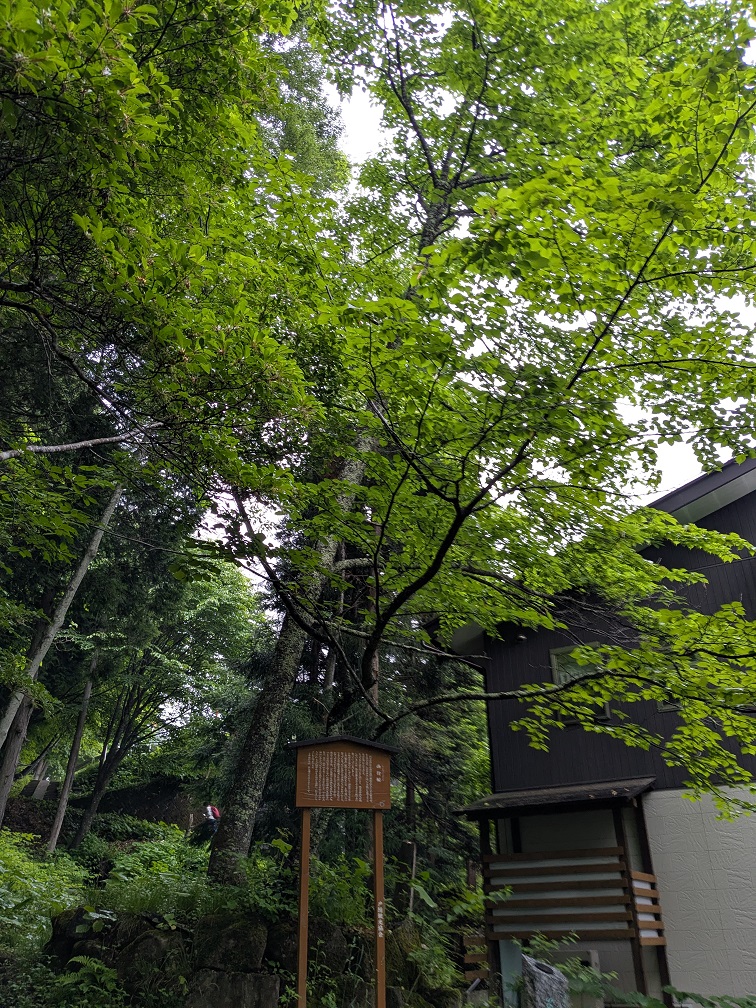
Speaking of Saigyouji Yuyuko, this is the Saigyou Zakura, which served as an inspiration to Saigyou Ayakashi. It might not be a titanic monster tree, but I found it's hardiness and age quite respectable nonetheless.
In Touhou, the Animal Realm is not a natural realm, but rather a dystopian hellish realm that is dominated by demonic animal spirits. As the realm is rather ruthless and merciless, it does fill the role of a realm dominated by base instincts and fear. Inhabitants from this realm are however later shown as interacting with characters that have animal-like traits from Gensokyo itself, drawing an association between Touhou’s hellish depiction and the natural world.
When it comes to the demonic realm of Hell, Touhou actually presents two hells. There is the Former Hell and New Hell. The Former Hell has at least to some extent lost its role of torturing sinners, and has become the dwelling and playground for spirits that are considered so despicable that they are not tolerated elsewhere. This a rather interesting take on the matter, as sometimes the archetype of Hell has been interpreted as a place where impulses which are not socially acceptable or safe to express are “imprisoned” or repressed. Another interesting feature regarding Former Hell is that in the music commentary for Subterranean Animism, before the New Hell was introduced, ZUN said that the Hell is empty because humans were no longer condemned to Hell. This was later contradicted with the introduction of New Hell, a decidedly demonic realm commanded by the fallen monk Nippaku Zanmu.
The creation of New Hell came about because Former Hell had become too full, old and bureaucratic to function. This caused Zanmu to propose the creation of a New Hell, and many followed her. This split between Former Hell and New Hell can be seen as reflecting the ways Japanese views regarding the afterlife have changed. Later Buddhist depictions of Hell were actually influenced by Christian missionaries' depictions of the Christian Hell, arguably creating a kind of new image of Hell in Japan. Another potential parallel is how the Japanese capitals used to be moved, with the last move being from Kyoto to Tokyo. Zanmu can then be seen as a kind of upstart figure who circumvented old power structures by moving to a new location.
Buddhism isn’t the only thing that influenced Touhou’s depiction of Hell, just like the Japanese idea of Hell wasn’t formed from Buddhist ideas alone. The Chinese ideas of divine bureaucracy were syncretized with Buddhism already in China, and became disseminated to Japan. Touhou has another mythological layer beyond this of rather unclear origin, but possibly related to certain esoteric interpretations of Hell in the West. Hecatia Lapislazuri claims that originally Hell wasn’t a place for punishing sinners, but rather a place where people who were not capable of “living virtuously”, who had “hearts of pure evil” and who sought extreme freedom voluntarily came to enjoy themselves. The blood pools were drinking fountains and pits of fire were used for roasting meat. In Hecatia’s account, this changed when Yama took over Hell and changed it into a place of punishment for sinners. Touhou’s depiction of Hell, especially the Animal Realm, retains this element of a realm of extreme individualists and egoists where a ruthless meritocracy ensures that even entities of godlike power can fail if they fall short of expectations.
A realm that is not explicitly referenced to in Touhou is the Asura Realms. The Asura are sometimes translated as “titans” or “anti-gods”, and they are extremely powerful, wrathful beings that are jealous of the deities and want to usurp their rule. Zanmu, the Animal Realm matriarchs and various incident-causing entities demonstrate Asura-like qualities at times. They do not explicitly fight against any kind of celestial deities, yet the attempt at usurping the order of Gensokyo might be seen as being something like this in the context of Touhou. Another possibility is that Makai of the pc98 games is a kind of Asura realm, as it’s hellish yet not a hell, being a place where powerful demons and youkai dwell. Alternatively, all of Gensokyo proper might be seen as an Asura Realm of sorts. Its powerful, prideful entities do things like try to cheat death and circumvent divine laws, as well as at times stand in opposition to forces which can be seen as representing celestial realms.
When it comes to the celestial realms, places which would unambiguously qualify as such are really only referred to, not shown in Touhou. Hinanawi Tenshi is a celestial, but she has been exiled for misbehaving and the Heaven where she comes from is never shown, only told to be paradisical yet dull. It’s known that Heaven has been closed, making it impossible for people to ascend or reincarnate there anymore. This is a rather grim interpretation of the higher realms. In Buddhism, the deva realm of deities is a place of opulence, not salvation, so this isn’t exactly necessarily out of line with Buddhist thinking either.
Another celestial - this time quite literally - realm shown in Touhou is the Moon, where a sealed-off magical city lies. The Moon’s inhabitants are split into two, deities and deity-like entities that are references to the imperial mythology of Japan, and a native species of Moon Rabbits which the former have enslaved. This too is a rather grim interpretation of a higher realm. The Lunar Capital is a Pure Land in the Touhou sense, a place where no biological life exists and nothing ever truly changes. The Netherworld is also a “Pure Land” like this. This is an interpretation that is rather divergent from the Buddhist use of the term, and is once again rather grim in nature.
When it comes to the highest realms in Buddhist cosmology, these are not really talked about nor demonstrated. These realms of enlightened beings would perhaps make Touhou too explicitly a work situation within Buddhism. Touhou certainly does have references to Buddhism, even people and youkai practicing it. Hijiri Byakuren was imprisoned in Hokkai, “World of Truth”, an otherworldly realm, but it’s situated in the monster realm of Makai, and her imprisonment was just that - imprisonment, not enlightenment. Another possibility of why these realms are not depicted or really talked about is possible conflation of folk beliefs in the enlightened realms being paradise-like, and thus the Heaven of Touhou would be also a Buddha-realm. It’s interesting to note that this is the one thing that ZUN doesn’t seem to neither confirm or deny, and therefore there is something that is too sacred for even Touhou to directly talk about or depict. This ambiguity of course leaves open the - to quote a spell card name - “Fantasy of Reaching Enlightenment” open. The last possibility is that conceptualizing the enlightened realms has been notoriously difficult even within Buddhism, and ZUN simply may not have come up with a way to depict them that he would find suitable or interesting.
Last but not least, Gensokyo has its own little Human Realm in the Human Village. Much like it tends to be to us humans, a lot of the events of Gensokyo really revolve around the humans. It’s the belief and emotions of humans that fuel the numinous and shapes reality. Buddhism tends to hold that excluding the enlightened realms, being born as a human is about as good as it gets because we are capable of perceiving all the realms and capable of reaching enlightenment with less effort than inhabitants of lower or upper realms. The lower realm entities are too wound up in their wrath and suffering, and the deva are too distracted by their pleasures which they think to be eternal. In Gensokyo, humans are at an ambivalent position. On the other hand they are essentially resources for the youkai and deities, yet they are also protected from the worst violence and things like natural disasters by the youkai and deities. Quite often it falls to the humans to mediate between the other entities and to resolve the “incidents” and “kerfuffles” which threaten the delicate balance of Gensokyo.
Another Human Realm present in Touhou is of course the Outside World. Touhou constantly plays with the ambiguous status of the Outside World as being not just like our present world, but as being literally our world. Especially in the later entries and print works, the events in the Outside World that have an impact on Gensokyo have very direct analogues in our world. This has of course annoyed some of the older fans, yet it’s a very logical follow-up to the idea of belief holding power. The Great Hakurei Barrier that divides Gensokyo from “common sense” is shown to be rather porous. Ideas, fads, trends, influences and even people from the outside seem to constantly end up inside. In turn, several youkai are able to pass out of fantasy and enter the Outside World. The radical implication of this all is that if humans became truly aware of their influence and power, they could intentionally shape their beliefs and overthrow the existing order of things. Yet even with all of the information accessible to people - including the idea that belief shapes reality - humanity seems to just recapitulate archaic structures and old myths, while sporadically coming up with bizarre new fads. In Touhou, the reason for this appears to be that these archaic structures, old myths and children of bizarre fads have a power and agency of their own, which uses humanity to shape narratives, which in turn shape themselves. Whether this is so or not in our own Human Realm (and even more importantly, if overthrowing the archaic structures would be a good thing) too is up for everyone to figure out for themselves.
When it comes to the Outside world, the other side of the coin for the sacred geography of Gensokyo is that Touhou also contains a great amount of references to locations in our world. Many of these places are historical sacred sites, while others have acquired importance to dedicated fans through their association with Touhou. Some of these sites have already been mentioned, but a go-over is deserved here.
The Suwa Taisha shrine complex, the real-life Moriya shrine and the geography of Suwa is prominently referenced in Touhou, particularly Mountain of Faith. The “Mountain of Faith” that inspired the name of the game is most likely Mt. Moriya. This sacred mountain serves as the go-shintai of Suwa Taisha Honmiya. In modern Japan, it’s fairly uncommon for a shrine to have a go-shintai, the “body” of the kami, that is a natural object. Suwa Taisha Maemiya is an exception to this. The onbashira that are referenced in Mountain of Faith are part of the construction of the Suwa Taisha shrines, and part of a notable matsuri in Suwa. They are great fir tree pillars that are used in designating the sacred territory of Suwa Taisha. Every six years they are renewed and new wood pillars are brought down from the mountains in a matsuri. This event can get quite wild and dangerous as people ride on the pillars as they are brought downhill. People have become injured and even died during the matsuri. The Wind God’s Lake that manifested with the Moriya Shrine in Gensokyo is a reference to Lake Suwa itself. Even the plotline of Subterranean Animism where Yasaka Kanako’s intervention causes a hot spring to appear is a reference to Suwa mythology, as the area has numerous hot springs which are attributed to Yasakatome dropping a cotton swab soaked in hot water on the ground.
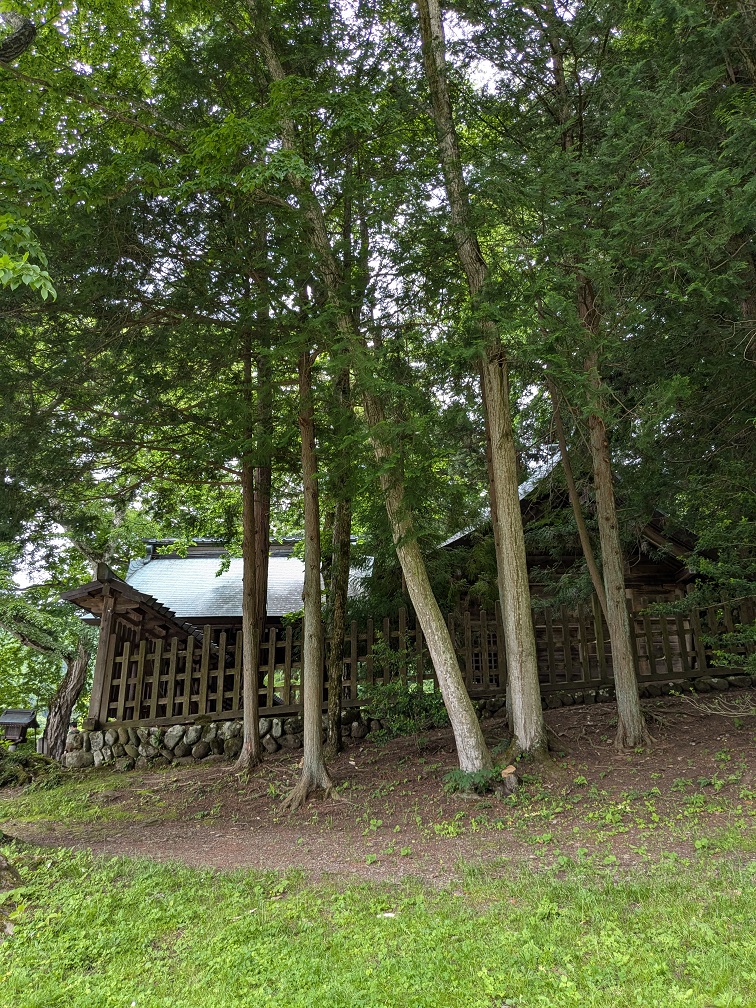
The Suwa Taisha Maemiya from a rarely seen angle.
Are you playing with native god?
Suwa Taisha shrines and the much smaller Moriya shrine, a family shrine of one of the old priestly families of Suwa shrines have become destinations of pilgrimages for Touhou fans. If one visits Suwa Taisha, it’s impossible to not notice the numerous ema prayer plates which have art of Touhou characters on them. There is a cafe near Suwa Taisha Maemiya that hosts a collection of Touhou fanart and merchandise, and the owner is very aware of the site’s nature as a destination of otaku pilgrimages. One of the more striking pieces of artwork that was there while I visited was an ofuda-style image of Yasaka Kanako. The locals appear to be aware of the interest shown by Touhou fans, but have not particularly embraced it in the form of official collaborations or anything such. Contrary to Touhou’s Moriya Shrine “passing into fantasy”, the Suwa faith appears to be quite alive these days on its own terms, and there’s been some kind of revival towards the traditional culture in the form of the Suwanism group, references in popular culture beyond Touhou and the Shika no Kuni documentary. At times the otaku pilgrimages have reached disruptive dimensions, as some people left excessive amounts of fandom merchandise as offerings on the Moriya shrine, which had no protocol for disposing of such things as they are technically offerings to the kami.
Mt. Moriya is not the only mountain referenced in Touhou. The Youkai Mountain in Gensokyo is said to be the “true form” of Yatsugatake Mountains, which is a mountain range in Nagano. Curiously enough, one of the peaks of these mountains is called Tengu-dake, or Tengu Peak. There’s mythology related to these mountains that ties it to the most iconic of Japan’s mountains, Mt. Fuji. It’s told that Konosakuyahanahime became jealous of Yatsugatake being taller than Mt. Fuji, and in a fit of wrath shattered the Yatsugatake into eight parts. This mythology ties into some very recent additions to Touhou lore, namely the character of Iwanaga Ariya. She is based on Iwanagahime. This deity was along with Konosakuyahanahime presented to the mythical emperor Ninigi no Mikoto. Ninnigi however rejected her for being too ugly. Because he chose the princess of fleeting flowers, his offspring, humans, were doomed to live short lives. Mythology sometimes considers the real-life Yatsugatake mountains the dwelling of Iwanagahime, and Lunatic in Runagate referenced these myths long before Fossilized Wonders.
The Asama Purifying Mountain where Iwanaga Ariya is imprisoned shares its name with Mt. Asama, found on the border between Nagano and Gunma. It’s the most active volcano in Japan. While there’s probably no ancient pyramids inside it, there is a mountain that has local legends about it being a manmade pyramid in Nagano. This is the Minakamiyama mountain. Besides the lore about it being a pyramid, there locals also have mythology that a cave on the mountain was actually the Ama no Iwato from Japanese creation myths. This site has also been the site of plans to evacuate the imperial family during the Second World War, of unusually frequent seismic activity and UFO sightings. It’s surrounded by ancient burial sites and is a Shugendo sacred site.
Mt. Haku, another Shugendo sacred site, and its possible connections to Touhou and the Hakurei Shrine were mentioned. It’s however quite notable how this association with Hakurei Shrine has been mapped into the real life Jomine Shrine in Hakuba, or rather its ruins. In a bizarre parallel with events in Touhou canon, this shrine was destroyed in an earthquake in 2008. This is after the release of Scarlet Weather Rhapsody, where Hinanawi Tenshi destroyed the Hakurei Shrine with an earthquake. Some have attributed prophetic qualities to Scarlet Weather Rhapsody after this event. This is a perfect example of the fandom elevating what could otherwise be a rather unremarkable local shrine into something connected to what is to them a broader mythology, complete with parallels to mythological events. Another curious Hakuba connection is that it’s referenced in one Castlevania game. The events of the game take place in future Japan, where the protagonist observes an eclipse in Hakuba, along with his girlfriend, the shrine maiden of “Hakuba Shrine”. One has to wonder if Dracula’s Castle manifesting in Hakuba was inspired by Embodiment of Scarlet Devil, where a Western-style vampire mansion appears in Gensokyo. So it’s possible that Touhou’s sacred geography might have started mapping itself outside of its own borders.
The last Shugendo sacred site referenced to Touhou is Mt. Iizuna, and its deity Iizuna Gongen. The connections to this site were already explored before, but what makes this place notable is how it serves as an example of a kind of “clustering” process that has happened with references to real life locations in Touhou. Near Mt. Iizuna is Mt. Togakushi, and while the Togakushi area is not directly referenced, there are two important connections to Touhou there. One is that one of the shrines there is a major shrine to Yagokoro Omoikane no Mikoto, who inspired the character of Yagokoro Eirin. Another thing that can be found in Togakushi is the Saigyou Zakura, a cherry tree associated with the poet Sagiyou. The Saigyou Ayakashi is the youkai cherry tree which Saigyouji Yuyuko tries to revive in Perfect Cherry Blossom.
Another cluster of references can be found around the Nikko and Okunikko areas. Presenting a change of locale, these are not located in Nagano but in Nikko. One can find the Nikko Toshogu shrine mausoleum there, a world heritage site that is rather popular with tourists. Related to Touhou, there is a Buddhist hall of worship dedicated to Amida Buddha there, which also enshrines Matarajin. Nikko used to be an important site of the Matarajin faith, and Tenkai, the Tendai Buddhist priest who championed for the enshrinement of Matarajin there, seems to have on some level attempted to turn Matarajin into a guardian deity of all of Japan. Tenkai’s plans failed, and this might have contributed to the downfall of the Matarajin faith. A more minor reference is that there is a wooden carving of a sleeping cat in the shrine complex, and this was referenced in one of the manga.
Moving towards Okunikko, one starts to find less direct references which have woven themselves to the sacred geography of Gensokyo and otaku pilgrimages associated with them. There’s the Kegon Falls. Treating them as a mere reference to one spellcard Nitori uses does them no justice, as these majestic waterfalls are a wonderful sight on their own. They are not “just” a waterfall, and they are considered sacred, even though only a very small shrine is next to them. Perhaps their awesome quality is so apparent that no grand shrine is needed here. Moving further up the mountains, one finds the Nikko Futarasan shrine. A photograph taken from stairs here was used as part of the ending graphics for Subterranean Animisms. A bit further up the mountains lies a stretch of river and smaller waterfalls which were used as reference for stage graphics in Mountain of Faith. Even further up there are highlands, photos of which were used as graphical elements in Phantasmagoria of Flower View.
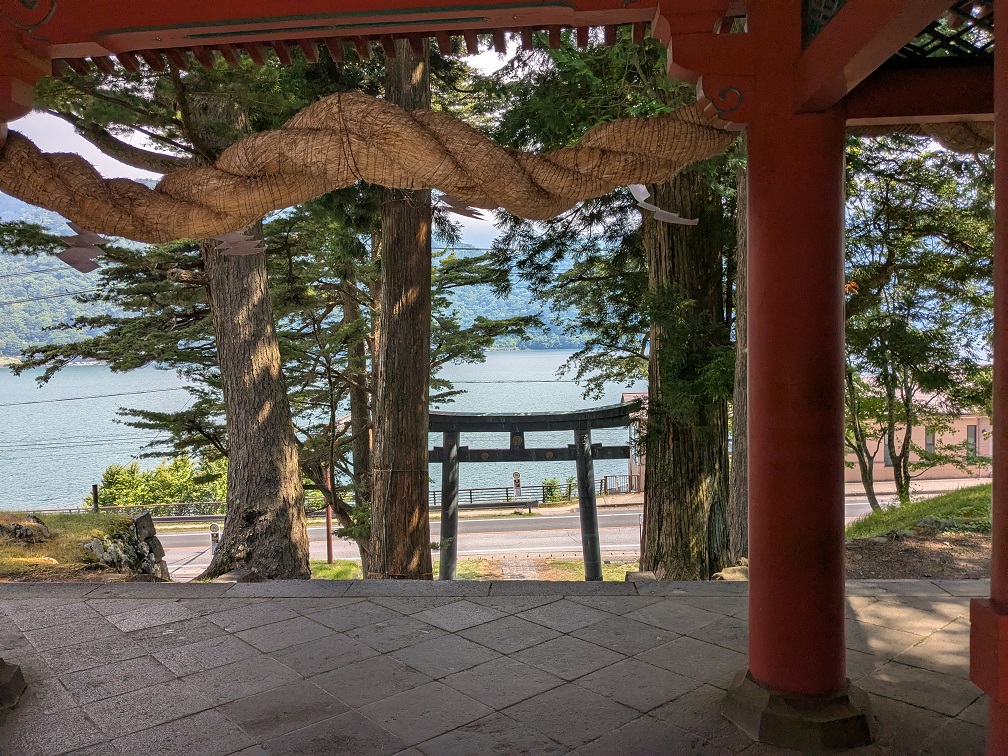
Nikko Futarasan shrine, to Touhou Fans of Subterranean Animism fame. To others, the site of a living spiritual tradition centered around its sacred mountain.
The Touhou fandom can be obsessive, and the games have been very thoroughly combed for all kinds of references, both textual and visual. The presence of a certain place in a graphical element associated with one of the games has turned these into locations where people make journeys to, taking photographs and sharing them on social media. Some of these places are presented in a manner which removes them from their local history and context. In turn Touhou, or perhaps the fandom, superimposes their own importance on these places. This is the aspect of the Touhou otaku pilgrimages which is most in line with other types of otaku pilgrimages. A street crossing, a school, a hillside view can become elevated in some people’s eyes by a reference in a popular work of fiction.
It’s when the older layers of mythology and importance start interacting with the newer layers that things become truly interesting. In other fandoms, there has at times been conflict with locals, and there have been challenges at disseminating proper behavior norms at sacred sites to people who live in a fairly secularized culture, and to whom their fandom and adoration might override prevailing norms. The example of the excessive fandom merchandise donations at Moriya shrine shows that this kind of conflict potential also exists in the Touhou fandom. It’s also notable that in the case of this incident members of the fandom intervened in Twitter and tried to educate others about proper behavior norms. In broader Suwa context, it seems that the locals are aware that the shrines are getting outside attention because of a video game, but this has not gone further in an official context. Sometimes sacred sites collaborate with modern fandoms, and one can find an example of this in the Touhou fandom too. The site in question is the Gohozan Kumano shrine. Noticing an uptick in visitors outside of the shrine’s vicinity, the priests inquired into the matter. They learned that a reference to the shrine in Subterranean Animism - Satori’s mansion’s stained glass is based on the insignia of the shrine - was driving Touhou fans to visit the place. The shrine launched an official collaboration with Touhou, offering shrine goods with Touhou-related iconography.
An interesting question that remains is at which point an “otaku” pilgrimage turns into a “real” pilgrimage, and if these kinds of distinctions are meaningful. People went on historical pilgrimages for a variety of reasons, and those Touhou fans who visit their own sacred sites do so for a variety of reasons too. As people engage in these pilgrimages, they inevitably come in contact with sites that are regarded as sacred. They come in contact with history and culture that has been tremendously impactful for many people generation after generation. They open themselves up for an experience, be it a social, aesthetic, cultural, religious - or numinous - one.
One way to think about certain locations in Touhou is that their history and mythology has indeed in some sense “passed into fantasy”, displaced from perceived reality through disenchantment. What makes otaku pilgrimages related to Touhou notable is that they open a possibility for things to pass out of fantasy. The mythologies associated with particular sites evolve and grow over time, reflecting more broader archetypes than literal truths. Deities have changed names and appearances. Perhaps a new mythology can re-sensitize people to the numinous qualities of sacred sites. New appearances might be needed in times where old appearances have been relocated into the territory of mythology, history, culture and fantasy instead of lived experiences. The amount of Touhou fans who become interested in the spiritual through their exposure to Touhou might not be huge, but it’s not non-existent either. Clearly the neo-mythology of Touhou holds at least the power to act as a gateway of sorts.
Much like the Great Hakurei Barrier, the mythological worldbuilding of Touhou seems to be more two-sided than initially appears. While it acts as a repository of mythology and a network of references, the act of coming in contact with it is never one-sided. We are constantly little by little changed by the world, and exposure to stories, narratives and mythology holds great potential to change us. In some sense humans are profoundly narrative-driven beings, we constantly churn out little stories about ourselves and the world, and when we come in contact with other stories, we incorporate them into ours. The co-creative doujin nature of Touhou encourages a particularly co-creative approach to begin with. Gensokyo is not just the creation of a single person, but a cultural network that binds together many different interpretations given to Gensokyo and its inhabitants. In becoming part of this network, for people some things start to pass out of fantasy. Language, culture, art and music are forms of communication which can build bridges, even to very distant places. Just below the surface in Touhou there are links to incredibly vast and deep traditions that deal with the most profound questions regarding existence itself and humanity’s place in the world. For some, becoming aware of these connections becomes life changing, and these things stop being just references in a videogame franchise.
It’s impossible to say to what extent this process of “passing into fantasy” has been intended to be a two-way thing. The very possibility of it however hints at Touhou being a shamanic form of art. While this idea might seem strange at first, closer inspection reveals several other potentially shamanic qualities to Touhou. Therefore, a look at Touhou as a shamanic form of art is the next step.
Touhou as a Shamanic Work of Art
Having now presented a broader context of Japanese spirituality that is tied to sacred sites in Japan and how Touhou is situated in this context, I now make a case for Touhou being a form of shamanic, channeled art. I fully reserve the right to be wrong about this, as what will be written here partly relies on statements by ZUN that can also be interpreted as some form of humor, or the cultivation of a kind of creative persona. However, even if ZUN was jesting and creating a peculiar public persona, there are still qualities in Touhou games that are related to broader mythological, shamanic archetypal complexes. Even in the case where ZUN would be insincere about some of his statements, there might be a kind of accidental shamanic quality to Touhou, a classic case of a joke becoming real: call yourself a priest as a joke enough many times, and you might just end up becoming something like that for real.
As the various archetypes can be acted out and transmitted without the people involved in their transmission being aware of this, no intention is needed to work with them. Mythology has power and appeal that is difficult to put into words for many, and I think it’s an exception for people to work with it consciously. I would say that Touhou does consciously work with a kind of neo-mythological mode of storytelling. The mythological mode is about fitting events into broad archetypical narratives. These are never a one to one fit with “objective” (as far as something like that could even exist) reality. By necessity, some interpretations of events, be they historical or fictional, become suppressed, and others highlighted. When the mythological mode is levied for centralizing aims, that never seems to fully work either. People constantly churn out their own interpretations and variations of mythology, and the suppressed narratives constantly peek out of the cracks.
Touhou’s neo-mythological mode in contrast works with archetypal themes, but this mode is extremely self-aware about how there is not a single agreed interpretation of events. Mythology gets messy and complicated, and the suppressed fringe is dragged to the center. ZUN gets sometimes labeled a “bad writer” by the Western fandom because he doesn’t stick to the Western linear narrative mode and the official works have inconsistent tone, worldbuilding and characterisations. I argue that it’s an intentional choice, a different way of storytelling, because it is resonant with a lot of broader trends in Japanese storytelling traditions. ZUN appears to be part of a lineage of writers like Ryonosuke Akutagawa, Natsumi Soseki and Mizuki Shigeru who have all worked with themes on the complexity of human perception, power of imagination and the collision of competing narratives. These earlier writers in turn would have been influenced by earlier traditions and social conditions of the day, things like the process of making various different religious worldviews fit together and the collision of modernity and tradition.
So what kind of broader archetypal themes can be found in Touhou? Let’s start looking at something that is impossible to miss, the protagonists. A lot of the main player characters in the games very easily slot into psychopomp or spirit guide archetypes. The easiest ones of these are of course Reimu and Sanae, as both are miko, and seemingly of a more shamanic type involved with “youkai extermination” and exorcisms. Reimu’s naming, “Esteemed Companion of a Divine Dream”, is deeply fascinating in this context, especially when one thinks of the importance the Japanese put to their “divine dreams” historicaly. Marisa is a magician, and while the term is notoriously nebulous, working as a spirit guide, exorcist and spiritual trouble solver were certainly roles such people could historically assume. Marisa’s Western styling, looking like an archetypical witch with her broad hat and broom is a fascinating choice for a series deeply steeped in Japanese culture.
Some characters fit the psychopomp archetype less straightforwardly, but can still be read as representing a spirit guide archetype. Youmu is a half-human half-phantom, half-alive and half-dead. This makes her liminal, with one foot in the world of the living and other in the world of the dead, a shamanic quality. She also works as an attendant to a powerful spirit, Yuyuko. This kind of relationship to a more powerful entity is also a feature of some psychopomp entities. Most would not think a maid could be a psychopomp, but Sakuya does a fair bit more than just dusting the Scarlet Devil Mansion, and she works for a powerful supernatural entity. I would argue that both Youmu and Sakuya can be seen as “douji” types, servants of powerful entities. Douji, often depicted as boyish entities, were a common type of spirit guides in Japanese shamanism. Reisen, who got spotlight in Legacy of Lunatic Kingdom, is a native of a spirit realm, coming from the magical dark side of the Moon. Spirits could of course be spirit guides. Rabbits are liminal animals, living both underground and under the open sky, so one can argue that they have a kind of realm-traveling potential to them.
Sometimes this kind of psychopomp nature gets highlighted even in the games. In Imperishable Night and Subterranean Animism, the player characters are paired with other characters acting as supports. These support characters tend to be of more spirit nature, being things like youkai or ghosts. The exception is Alice who teams up with Marisa in Imperishable Night, and guides her in Subterranean Animism. Many have read this in a romantic light, and while I think it is a legitimate interpretation, I think it can be seen as a kind of mentor-student relationship in a sense. Alice is implied to be a much elder, potentially much more eldritch magician than Marisa, one who has completely given up on her humanity. Her name comes from Alice in Wonderland, and while her canon relationship with Marisa seems to be mostly one of friendly rivalry, perhaps she can be read as someone who has “gone through the rabbit hole” fully, and is closer to the spirit world than Marisa herself is.
Because of the nature of the player characters and the kind of activities they get involved in, one way to view the Touhou games is as a kind of simulated spirit journey. Gensokyo can be seen as a kind of spirit world of its own, or alternatively an axis mundi type of structure that connects to other realms. Many of the games feature journeys to places where real-life shamans would also go, like the underworld.
In Touhou’s case, these journeys remarkably often lead to the underworld. One potential reason for this is that hellish and netherworldish figures are traditionally seen as antagonists, but there might be other reasons for this. ZUN might be unwilling to commit to a particular depiction of the upper realms, be they in Taoist, Buddhist or Shinto form in order to not legitimize one religion or another. Another possible interpretation is that it’s related to Touhou as a repository for things that have “passed into fantasy”, in some sense “died” and moved to a kind of “netherworld” which Touhou (among other media working with these traditions) serves as. Izanagi’s journey into the underworld is of course part of the foundational mythology of Japan and thus the idea of an underworld journey has a large cultural footprint in Japan. Another mythological precedent in Japanese culture for journeys to the underworld and hell comes from Buddhism, where the most common spirit journey type of experience reported for Buddhists was towards these realms. There they would often meet Jizo, Enma or both, sometimes these two being two sides of a single entity.
Another potential reason for Touhou’s fondness of the lower realms is that sometimes underworlds and hells are seen as representing things that are personally or culturally repressed. These include things like death, violence, greed and excessive sexuality which are socially or individually disturbing. This view can be brought into harmony with one that takes the existence of spirits for real by seeing the underworld as hells as having spirits which represent, cultivate or feed upon these things. Sometimes these are conceptualized in a kind of therapy-speak way as being elements of humanity that society has deemed “not safe” to embody, but I would personally argue that certain “hellish” qualities like violent tendencies are perhaps best left in the underworld. Whatever your view on these things may be, there is however something that tends to become culturally repressed that makes this very relevant to Touhou. That is the power of women, including the spiritual power of women, in society.
You can very much make a case that Touhou is a kind of outpouring of the repressed divine feminine in Japanese culture. It’s full of miko, witches, goddesses and powerful female monsters. Women used to have an important role in Japanese spirituality, but one which came to increasing control from the organized religions. Even as social control tightened over the centuries, it was really only the embarrassment of the Meiji era over perceived “superstition” that put the nail onto the coffin of the shamaness. And as soon as it became possible, she revived herself in the form of various new religious movements and depictions in fiction.
The spiritual importance of women might have been even greater than what is known today. There are powerful women in the imperial myths, figures like Amaterasu Oomikami, Ame no Uzume no Mikoto, and Empress Jingu. Several important kami, including ones like Yagokoro Omoikane no Mikoto however have unknown or ambiguous genders. This doesn’t necessarily mean they were perceived as female, perhaps they were seen to be completely abstract entities. However, there is some precedent at attempted masculinization of the Japanese pantheon via medieval Buddhism associating Amaterasu Oomikami with the male-depicted Dainichi Nyorai and Uho Douji. There is also at least one potential later example of a deity becoming masculinized, and that is Matarajin. It would be rather curious indeed for Touhou to coincidentally host several deities which might have been initially historically seen to be female.
The trope of the demonic or undead female has been a rather big part of Japanese folklore for a long time. There’s an interpretation that sees this trope as stemming from the myth of Izanagi meeting the dead yet living Izanami at Yomi, but other reasons for it can be found. It can perhaps be seen as literal demonization of women. This is certainly one possible part of it. Historically, there was a tendency in Buddhism to view women as being lower than men. There were even popular, yet apocryphal, non-canonical, sutras that described horrible hellish punishments for women in the afterlife. Beyond being seen as lower than men, there seems to have been genuine fear of the spiritual power of women. An example of this is the Genji Monogatari, where the strong, disturbed emotions of a court woman cause her spirit to leave her body and terrorize others, unknown to her. Thus the “undead woman” archetype can be seen as a wrathful manifestation of the repressed divine feminine, coming to haunt the visible world.
Touhou’s feminized take on Japanese mythology and history can be seen as a kind of un-repressing of the feminine side of Japanese mythology and history. The nearly all-female cast calls attention to things like the ambiguous gender of certain historical deities and figures, and how Prince Shoutoko wished to be associated with the androgynous Kannon Bosatsu. As many of the characters are youkai, undead or demons, it can also be seen as a kind of humanization of the “undead woman”. The monstrous women in Touhou retain some of their edge and troublesome qualities, but I would argue this only makes them more human, more complete and whole as characters. The goddesses and youkai of Gensokyo are powerful, autonomous and have a will of their own, often to the point where it causes problems for others. One could almost read Touhou as a tale of how power is exercised in a matriarchal society, particularly the print works.
Lotus Eaters is particularly fascinating when it comes to this aspect of women wielding social power. Its background plot features powerful youkai women plotting against each other to increase the influence of their respective clans in the human village. Their means are rather indirect and convoluted, and involve sometimes what is essentially rumor-mongering. The Tengu, who like to think themselves as being on the top of the pecking order of Gensokyo yield almost entirely social power through information and mis-information. The women of Gensokyo fight battles of fame and favor over who throws the best party, has the biggest and tastiest banquet or has the prettiest fireworks. Even the final word for resolving conflicts, danmaku, is a bloodless affair, judged for its beauty and not power. It’s a stark contrast to a duel to the death at sunrise - or a sumo match if you want to be really traditional about it - as a method of solving conflicts that perhaps a more masculine take on Gensokyo would perhaps have. Touhou’s treatment of these feminine means of conflict borders on the dignified, elevated, raised to a kind of art, much like a fighting manga could elevate what would be a sordid drunken brawl between men into art. By doing so, Touhou releases these competitive, hostile aspects of women from Hell.
The divine includes both the light and the dark, the horrible and the lovely, the hated and the loved. It’s the coincidencia oppositorum that Eliade wrote about, the unity of being. Thus the repressed side of the divine includes all of these too. And in Gensokyo, for every contrived plot hatched, every struggle of who has the tastiest sake, every incident caused by someone’s ego overflowing, there is mercy, joy and deep friendship. The battles are bloodless, enemies become friends and integrate into the timeless mythical time and space of Gensokyo. And even in this, there are traces of the opposite - physical brawls, threats of violence, even occasional deaths. The world is complex, the spirit worlds are complex, and Touhou too is complex and at times contradictory.
Shamans interact with spirits, and Touhou is of course all about interacting with spirits. The majority of the cast are things like youkai, ghosts, demons or deities, all fitting under the spirit umbrella. A lot of the troublesome ones are the same things which were in our world thought to also be troublesome, such as oni, kitsune and tanuki. Sometimes their antics are very traditional, and sometimes not quite so traditional. Often they assert their right to exist on their own terms. A setsubun is a ritual designed to drive out oni, but it’s also something that at least some of the oni look forward to, as they get to play their part. There’s at times an implication that the monsters act as a kind of safety valve, giving vague anxieties a form, shape and name, allowing humans to deflect internal pressures outwards and to manage fear and worry. The Outside World, lacking traditional tools for this process, instead churns out urban legends and conspiracy theories.
Working with troublesome and repulsive spirits is part of shamanism, and the heavy focus on such types of spirits in Touhou can be seen as part of this continuum. When it comes to how these spirits were dealt with in historical Japan, it wasn’t always exactly what Westerners would imagine an exorcism to be like, nor was it “youkai extermination”. It was thought that spirits could cause possessions and trouble for three reasons: to make a request, as an act of vengeance, or out of sheer spite and hate. Requests could include things like ancestral spirits voicing displeasure at neglect, or kitsune demanding fried tofu. Fulfilling this request was the way to resolve these types of incidents. Acts of vengeance could be caused by people offending spirits, and a kind of settlement could more often than not be arranged. It was those spirits acting out of malice towards humans that were the most troublesome and closest to the kind of wrangling with demons that Western imagination perceives exorcisms to be.
Sometimes dealing with even the most troublesome and hostile spirits included something that is perhaps very hard for Western people to understand - building shrines and making offerings to them. It’s good to remember the Japanese idea that there were no truly entirely “evil” spirits. Just like the angry onryo of Sugawara no Michizane became worshipped as the scholar kami Tenjin, all kinds of spirits could be appeased into becoming kind of household deities. There is a deeply fascinating case to be made for Touhou serving as something like this process. It takes “repulsive” and “weird” youkai and turns them into something appealing, with rich inner and interpersonal lives. Presented in this new light, they rouse very real inspiration, even devotion in people. As Touhou has gone global, they have transcended the very limits of the land and culture they were born in. One could see Touhou as a pathway, vessel or method for a kind of youkai apotheosis. And for those among its cast who are described to be of divine nature, it has offered global reach and a new form and mythology to live through. This same idea of turning troublesome spirits into less troublesome ones seems to explain why Reimu’s chosen methods of “youkai extermination” so frequently include becoming friends with them.
Another type of spirit that shamans frequently interact with are the ancestral spirits. Touhou has certain ghostly characters who seem to be aligned with real-life people and lineages, and can perhaps be seen as representing these types of spirits. Saigyouji Yuyuko appears to be a reference to the poet Saigyou, and Soga no Tojiko is a reference to the historically powerful Soga clan. There is however a case to be made that in some sense the various Japanese traditions and references to historical people constitute the “ancestor spirits” of Touhou. In Japan, it’s traditionally thought that if the needs of ancestor spirits were not attended to, they could cause problems to make their demands heard. Perhaps history has a kind of compelling weight of its own that demands to be seen and heard.
Touhou’s belief-driven ontology creates strange, paradoxical rules for interacting with spirits. Even entirely made up ritual, spectacle and narrative engineering become very real tools for interacting with spirits in the world of Gensokyo. As we have seen, ritual, spectacle and narratives and their impact on people are of course part of the real-world shamanic toolkit too. Certain writers, like Marvin Singh would argue that they are essentially the whole toolkit. Certainly these things have a psychological and cultural impact. But in Touhou, narratives, beliefs, stories and rumors can come to life in ways that are very concrete, and can be catastrophic. In Gensokyo, reality very much is what people believe. Even in the Outside World, this magical aspect of reality has not been undone by the seeming progress of science. Gensokyo is not shaped only by what those living there believe, but also the beliefs and memory of those outside of it. Implicitly, the only thing constraining "magic" in the Outside World is that people have deemed such to be outside of "common sense". Scientific frameworks have been accepted as the most reasonable explanations, and in turn the belief in these frameworks is implied to make them real. By the timeline of the Hifuu Club, set in the far future, science itself has however become unverifiable. Humanity cannot muster the resources needed to construct technologies capable of generating the unfathomable amount of energy required for new physics experiments. This idea is rooted in real-life limitations regarding certain fields of physics. As science once again becomes a mostly theoretical affair, it allows the fantasy and mystery to blossom once again in the hearts of the protagonists of those stories. This allows them to access the timeless time and placeless place of Gensokyo. Maribel even goes through a kind of shamanic sickness after being bitten and infected by a "chimera", possibly a youkai. This violent contact with a creature existing outside normal frames of reference and its aftermath awakens her supernatural powers to a previously unseen degree.
Speaking of transformations, the process of becoming something else than an ordinary human, “xenizing” as Singh calls it, has been a feature of shamanism in many different cultures. At first glance, Touhou treating things like “magicians” and “saints” as being kind of like different species compared to humanity feels perhaps a bit strange. However, there is cultural precedent for this in Japanese culture. There was historically a kind of “nonhuman” quality to certain spiritual practitioners, particularly the ascetics who withdrew from civilization. Especially the yamabushi were seen as being advanced to non-human creatures, the Tengu. The extreme ascetic regimes mediums and exorcists engaged in no doubt made them stand apart from ordinary people. The Taoist ideas of cultivation attributed superhuman qualities to advanced practitioners, up to immortality. In other cultures, shamans were seen as transformed humans who were changed by the spirits. Touhou has a great many characters who began as one thing and then became another thing: humans turning into youkai by learning magic, Taoist immortals, ghosts, but also objects that have come to life. I would argue that transformation and the kind of liminality it brings is one of the most often repeated archetypal themes in Touhou.
Another kind of shamanic quality in Japanese context is how Touhou appears to stand in at least implied opposition to imperial mythology and dominant religious narratives. Several kami associated with the imperial mythology appear, either as slightly fictionalized versions (such as Watatsuki no Toyohime and Watatsuki no Yorihime) or then just as direct references. Toyohime and Yorihime are the most prominent of these deities, and they are part of the Lunarian culture. The Lunarians view life itself as a kind of sin and impurity. They live in an unchanging fantasy land on the dark side of the Moon, far away from Earth, served by natives of the Moon they enslaved. Yorihime is shown to possess the power to call forth deities very deeply related to imperial mythology, including Amaterasu Oomikami herself. While these deities are not exclusively for the Lunarians to call forth, Reimu attempting to call these deities on Earth caused a stir among the Lunarians and they forced Reimu to perform kagura dances for them as a form of apology.
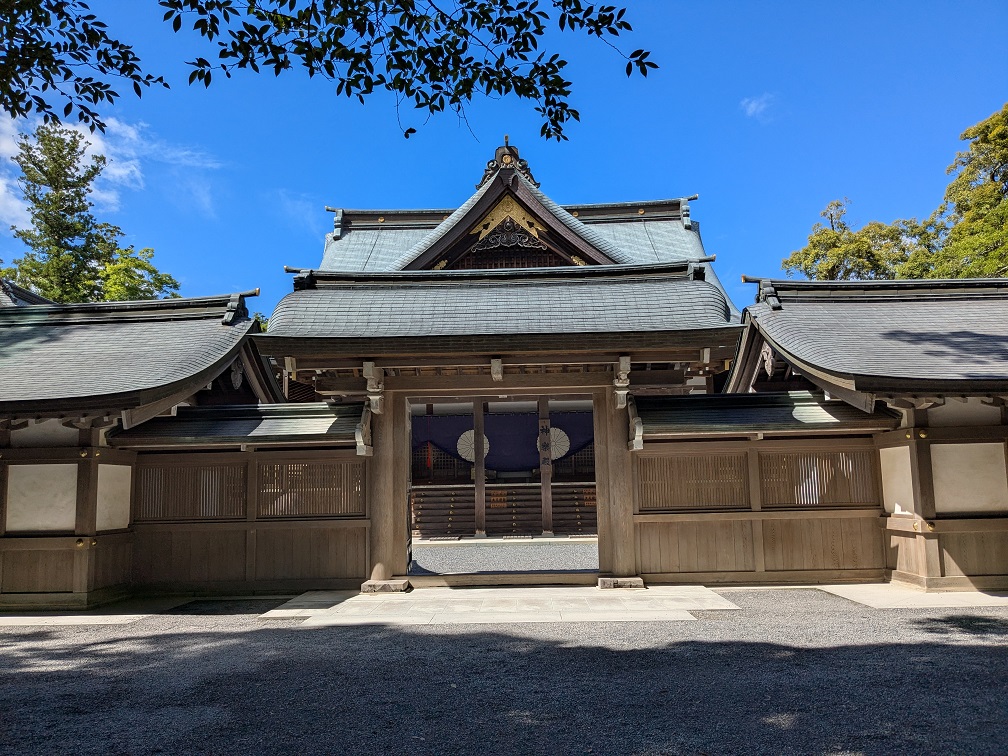
The kagura hall at Ise Jingu, the shrine that enshrines Amaterasu Oomikami. Reimu would have been made to dance in something like this on the Moon.
I think it’s entirely plausible to read the Lunarians a critique of the Japanese imperial system, or perhaps more broadly a kind of conservative social elite. An “unsanctioned” miko causing a disturbance and being forced to play along for the Lunarians can of course be read as a parallel to the process of the real miko becoming “tamed” by the imperial system. This too, and the whole tale of Lunarians standing apart from and at times in opposition to inhabitants of Earth, of course reflects an even deeper mythological layer of Japanese culture, the ancient struggle of amatsukami and kunitsukami over the rulership of Japan. While this layer can be read in political terms, it can also read in allegorical terms, and is perhaps intended to be subject to multiple possible interpretations. An undivided reality is a complex reality, and Touhou reflects this in its own way.
Shamanism features working with spirits using altered states of consciousness, often a state of trance or extreme excitation. The Touhou games certainly have qualities that are conducive towards the creation of a kind of trance or flow state. While the same can be said for a lot of different games, I find this quality particularly interesting when it’s paired with the broader mythological themes of the games. The simulated spirit journeys, strange mandala-battles and constant repetition are not quite like the ascetic regimens of old times, and these qualities shouldn’t be overstated, but there is something quite particular about how the mythology and gameplay comes together in Touhou. I think it’s this union that brings out a lot of the more unusual qualities like “nostalgic”, “souled” and “haunted” that people attribute to these games. The loud, brash and fast music and the firework-like swirls speak of a side of Japanese spiritual traditions that is sometimes overshadowed by stillness and calmness. Touhou is not zazen and tea ceremonies, Touhou is wild dances and loud matsuri.
The way Touhou re-contextualizes and passes on Japanese culture and mythology can also be seen as a shamanic quality. It’s thought that in pre-literate time, the miko had an important role in preserving and passing on knowledge and culture. Some have even attributed the birth of Japanese poetry to shamanic practices, calling miko the “womb of poetry”. Considering how important poetry used to be in Japan, they might as well be called “womb of culture”. While this role decreased in importance by the time of the arrival of written language in Japan, it didn’t vanish entirely. For example, while very little is known of the Hieda no Are who compiled Kojiki, there’s indications that she was a woman who came from a miko lineage. Thus the transmission of mythology into a written form would have been a new manifestation of an older storytelling tradition. In modern times, Japanese mythology has become adapted to modern media and modern times, and Touhou is part of this chain of transmission.
As a doujin form of art, Touhou is not the sole property of ZUN. While the fan interpretations of Gensokyo and its inhabitants come in all kinds of forms, some fan works seem to tap even more strongly to the mythological root and shamanic qualities than the official works do. There’s a lot of fan art which really pushes the mythological inspirations and archetypal qualities to the forefront. One form of fan work I find particularly intriguing are songs which are sung from a character’s perspective. While these too vary greatly in how their subjects are portrayed, some of them do feature mythological qualities very prominently. These have a strangely shamanic, medium-like quality to them, as if the woman singing them is acting just as a transmitter between us and something else.
The kind of shamanic qualities present in Touhou might not be accidental, but rather a reflection of their creator, ZUN. While ZUN has not called himself a shaman, he does call himself the “High Priest of Hakurei Shrine” and has done so for a very long time. Him toying with religious terminology isn’t limited to just himself. He named Reitaisai, the annual Touhou fan convention, after a category of Shinto shrine festivals. The organizers had approached him with another name suggestion, which ZUN had disliked. While one may read this all as humor, it does establish a link between Touhou and religion. You could in some sense view Touhou as a kind of para-religion that works with mythological themes and narratives present in Japanese spiritual traditions. It carries within it archaic cultural currents, but in a form that is not directly associated with the complicated history and institutional burdens of Japanese organized religions. It does not ask one for faith, but rather represents a fantasy of a world where the gods, ghosts and monsters are simply real. It does not offer first and final answers and a dogma, but rather an anti-dogmatic, complicated, relative view of the world.
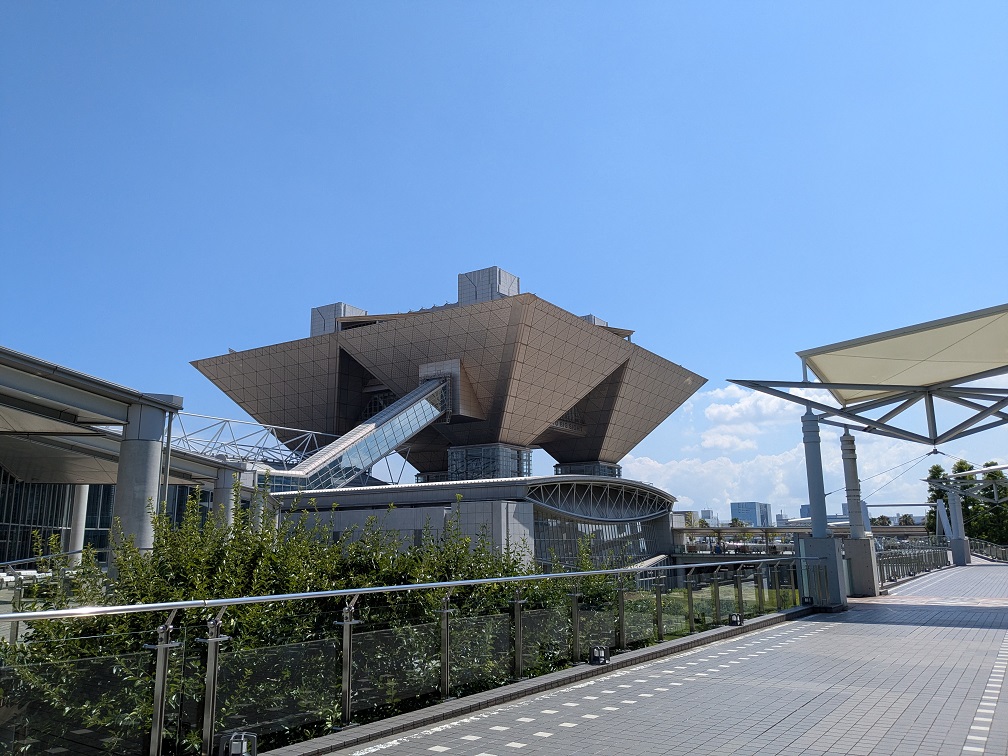
The Tokyo Big Sight convention center, site of Reitaisai and a kind of pilgrimage site for Touhou fans. It is quite a big sight indeed.
While one can see these as anti-religious qualities, and ZUN does apparently have quite the distaste for organized religion, paradoxically these might just be the qualities of how the spiritual manifests in the world. If one studies even just the history of Japanese faiths, one will find that deities have been part of multiple faiths under multiple names, changed appearances and genders and roles. The numinous is messy, complex and evades simple human categories, coming from the undivided reality. And if one truly believes in the numinous, then it has to be something that exists independent of humans and therefore their institutions, territorial feuds and blood-soaked history, yet is also tied with them. A world where the numinous exists is one where it constantly finds new manifestations and forms in an endless interplay with humanity. If one believes in these things, then Touhou does quite a wonderful job capturing certain aspects of the numinous. The High Priest of the Hakurei Shrine might have very well earned his job title.
It should also be noted that if one views Touhou games as a kind of simulated spirit journeys, then ZUN of course is a kind of psychopomp, spirit guide himself. It is his games after all that we are playing. There is a kind of magical, ritualistic quality to Touhou. It constantly plays with the relationship between fiction, mythology and reality. One of my favorite examples of this is Unconnected Marketeers. Tenkyuu Chimata, the market goddess who serves as the antagonist, tells after being defeated that she created the Ability Cards which caused the incident as collectibles because “everyone loves the characters of Gensokyo”, breaking the fourth wall. Being a deity of special markets, she is also in part a reference to the convention culture surrounding Touhou, in particular Reitaisai. The physical markets dwindling which resulted in her “passing into fantasy” is a reference to the COVID pandemic. This is where the story gets very interesting. Because of the 2020 Tokyo Olympics, the Reitaisai of the year was planned instead to take place in Shizuoka. COVID came along, the Tokyo Olympics were performed a year late and without spectators, and the Reitaisai was cancelled. What makes the change of location to Shizuoka of interest is the fact that the Shizuoka Sengen Shrine is there. In there, a deity called Kamuo Ichihime is enshrined. She is considered to be the second wife of the troublesome storm kami Susanoo no Mikoto and is worshipped as a market goddess. This creates a complicated weave of references to real world events and mythology, that borders on feeling synchronistic.
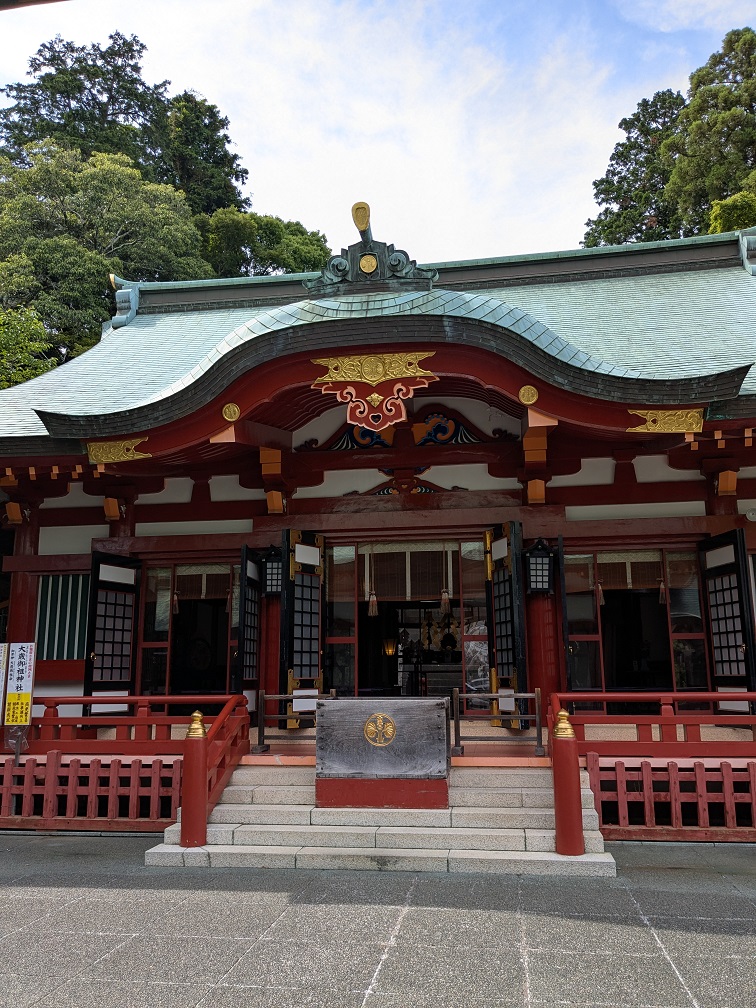
The shrine at Shizuoka Sengen Jinja shrine complex that houses Kamuo Ichihime.
An even more explicitly ritual-like piece of Touhou media is the Whispered Oracle of Hakurei Shrine. In this book, Reimu performs a large divination ritual in order to stabilize Gensokyo after the crisis caused by Tenkyuu Chimata’s appearance that had returned relations of ownership in Gensokyo into nothing. This state of instability threatens Gensokyo itself, and Reimu is tasked with creating a ritual that essentially names and states the nature of all the central figures of Gensokyo. This serves as the fictional (or mythological) basis for the 128 omikuji in the book. The omikuji are a popular form of divination in Japan that comes in small paper slips commonly sold at shrines and temples. They are divided between different grades of fortune or misfortune, and contain specific fortunes for various aspects of life. In the Whispered Oracle, the omikuji are essentially short character profiles which double as functional omikuji, complete with instructions for casting the divine lots.
The idea of using a ritual to stabilize a community after a disaster is not a uniquely Japanese idea, but it does feel deeply resonant with Japanese culture. As the country is prone to natural disasters, its inhabitants have taken the attitude that all that is made by humanity might get wiped away. Society can not be laid in stone if stone can crumble in earthquakes or be toppled by typhoons or tsunami. Therefore, the community must find more insubstantial means to carry on its heritage. Rituals offer a way to connect with numinous and ancestral forces that have guided the community since ancient times, yet these forces are not one of stasis either. The mythologies of Kojiki and Nihon Shoki are dynamic, full of conflict – and yet also the resolution of these conflicts and the creation of a new kind of order.
Gensokyo exists by ZUN’s own admission in a kind of a state where time does not advance as it does in the outside world, yet it is not a static, unchanging one. There are incidents, but after every incident – perhaps analogous to a natural disaster – a new status quo that adapts itself to new inhabitants and influences emerges after a kind of class of ritual specialists resolve the incident. It’s extremely noteworthy that the way to resolve this particular incident is to essentially restate the nature of Gensokyo’s inhabitants. By placing names and characteristics upon things you pull them out of the undifferentiated state of limitless potential of ”nothing” and turn them into something. All of Touhou’s canon plays heavily with this idea of how belief, perception and categorization shape things, so this is very much a refinement of these ideas.
One could see that this process of restating the nature of Gensokyo and its inhabitants extends outside of its fictional (or mythological) framing. It was a way for ZUN to reinforce the Windows-era canon as the true cast of Touhou. It also served as a way to flesh out a few characters that had very minor appearances, but which had become elevated by the fandom over time. It also served as a way to wrap up older narratives and to clear the way for Fossilized Wonders, which released very close to Whispered Oracle. It also raised energies and interest before the release of that particular game. There is also the curious aspect of fictional characters that are in-narrative shaped by perceptions using a framing associated with religion to assert their own character… This is very much in line with broader narrative strands in Touhou of those who were deemed to vanish reasserting themselves again.
When it comes to the topic of fictional characters asserting themselves, on several occasions, ZUN appears to have attributed a kind of agency to various Touhou characters. In the afterword to Symposium of Post-Mysticism, he states that while writing the book he was surprised by the historical depth of his own characters, and that some “troublesome ones” seemed to “move on their own”. During an appearance on a stream after the release of Fossilized Wonders, he stated that the “characters decide when they appear”. This seems to include him apparently “not knowing” what Yorihime was doing during the events of Fossilized Wonders, which involved her sister. In a later episode of the stream, he talked about his creative methodology and how he works with music and illustrations during the night and that he “goes into a trance” while doing so. While it’s possible that this was an exaggeration of a creative flow state, it’s still a rather interesting choice of words.
There is of course an argument to be made that much of ZUN’s activities could be a kind of construction of a creative persona. As we will later see, certain authors related to the topic of youkai have indulged in a kind of self-fictionalization of their lives and construction of creative personas. ZUN might call himself the High Priest, but he is most certainly also part of this tricksterish cultural lineage in Japan. My view is that regardless of his intent - the whole thing might have originally been a throwaway joke - this self-declared role seems to have accumulated a kind of potency over the years. Whether he knows it or not, does it intentionally or not, he has been acting in a more priest-like (or magician-like) role since at least Unconnected Marketeers, possibly for far longer.
Ultimately Touhou has escaped the confines of its creator’s intent. As a doujin work, it was always more communally oriented than some other forms of creative work would be. Much like a shaman involving the community in a ritual, those who take part in Touhou become its co-creators. ZUN himself has stated that after he dies, he hopes that Touhou becomes like Lovecraft mythos, free for people to make their own vision of. This is a tremendously interesting wish considering the occult legacy of H.P Lovecraft. While the occultism in his fiction was always that, fictional, and with very few direct references to real occult traditions certain later Western occultists started taking his works rather seriously. An example of this is the so-called “Simon Necronomicon”, a book on magic that purports to be the infamous Necronomicon from Lovecraft’s mythology. The authors of this book were Western occultists, and reported strange phenomena manifesting while writing it. The esotericist Kenneth Grant was deeply inspired by Lovecraft and worked the mythos as part of his occult system. Later, the infamous accelerationist philosopher Nick Land was inspired by Lovecraft’s vision to conjure his own ideas of techno-occult forces from the future invading the past.
I don’t know to what extent ZUN is familiar with this side of Lovecraft’s legacy. Only time will tell if in a few decades we will have someone creating the real Grimoire of Marisa. Maybe it won’t even take decades. As Touhou has been more than capable of rousing an interest, even contact with the numinous in some of its fans (this work being more than ample evidence of it) it might not require posthumous efforts to coax the magical out of its corpus. Every single lore item internalized has the power to ignite love for mythology. Every single one who becomes interested enough in its worldbuilding to study it will come to learn about real traditions. Every otaku pilgrimage to some shrine has the potential of turning into another kind of a pilgrimage. After all, if the numinous exists, it exists and is out there. What Touhou does at the very least is that by blurring the lines between fantasy, reality and mythology, it cracks open a space of possibility. Like a tree sapling pushing into cracked concrete, it might allow for something unfathomably ancient to manifest in a new form.
Fossilized Wonders felt very much like passing on the torch to the community. It might not be the last Touhou game, but ZUN himself said that he would be fine if there would be no more Touhou games. Even if there would be more Touhou games, I feel like on some level a certain threshold has been passed. The dream no longer needs its dreamer. What lies beyond the eternal return cannot die, and it might not take even a single strange eon for what was condemned to pass into fantasy to pass out back into reality. We are living through a kind of wave of re-enchament, witnessing the emergence of a kind of neo-animist movement in the West. As certain aspects of Japanese culture and therefore Touhou are already extremely resonant with this thinking, it will be fascinating to see how these two streams will mix if this cultural trend crosses into Japan.
Conclusion - The Neo-Mythology of Touhou
Over the course of this work we have taken a very broad look at the history of Japanese spiritual traditions that are relevant for Touhou, and how Touhou is situated within it. It’s not a complete look at all of the spiritual history of Japan, but rather one which has used those traditions explicitly named out in Touhou as a starting point. To get the full picture, a much more extensive text would be required. In some ways this is an impossible task, as the Japanese spiritual landscape is very much alive and evolving, not something frozen in time.
Incomplete as it may be, the journey so far has hopefully illustrated how Touhou sits into the spiritual landscape of Japan. It’s part of an extremely long historical continuum that is deeply tied with many physical locations. Touhou reflects the complexity of Japanese beliefs about the nature of spirits and the spirit world. It’s a product of a certain time, place and subculture, coming from an era and place that sought new ways to approach the Japanese cultural legacy. Touhou presents a kind of alternative neo-mythology that highlights the marginalized and acknowledges the complexity of the world while also tapping into the powerful mythological archetypes.
This neo-mythology can serve as an invitation to explore Japanese culture, history and spirituality in ways that turns Touhou into a portal into something much, much more vast. Some might even discover that their longing for Gensokyo has been in fact longing for something completely different. To what extent one believes in things like the power of belief in shaping reality, the existence of spirits and the promises of spiritual traditions is up for everyone themselves to explore and experience. The point is that Touhou can serve as a starting point of very serious exploration into extremely perennial themes of human existence. There is a reason why certain things stubbornly refuse to pass into fantasy.
At the same the way this neo-mythology embraces the complexity of the world and conflicts within it can serve as an immunization to the worst aspects of the spiritual search. Becoming exploited by corrupt institutions, swindled by fraudsters, consumed by paranoid manifestations of superstition or becoming extremely convinced of a single dogma are sadly common events among those who get inspired to explore the spiritual side of reality. Even worse, some become the corrupt exploiters and fraudsters and paranoia-mongers themselves. Touhou is very frank about this dark side of spirituality.
Even if one is not inspired to start some kind of a spiritual journey or deep historical and cultural research, understanding the neo-mythological mode clears a lot of confusion about certain aspects of narratives and worldbuilding in Touhou. The Western fanbase is mired by complaints about flanderization and mischaracterization of the characters, even the setting itself. Understanding where Touhou is coming from would help with these issues. For some, understanding where Touhou is coming from could spark a much wider interest in and understanding of Japan, and for some it could be the start of a lifelong transformative journey.
The journey so far has been a rather long and extensive one, but there is one more direction we have to travel towards in order to understand where Touhou is coming. So far this journey has moved along the dayside of Japanese spiritual traditions. Next we will move to the nightside populated by strange apparitions that slip easy definition and creep out of the shadows in new forms every time they are vanquished by being categorized, explained away or being stuffed into a museum. There, we will find the origins of Touhou’s most reality-bending narratives, as well as much of its cast. Where we are going next is of course the world of youkai.